

Key Takeaways
Dietary Supplement Regulation
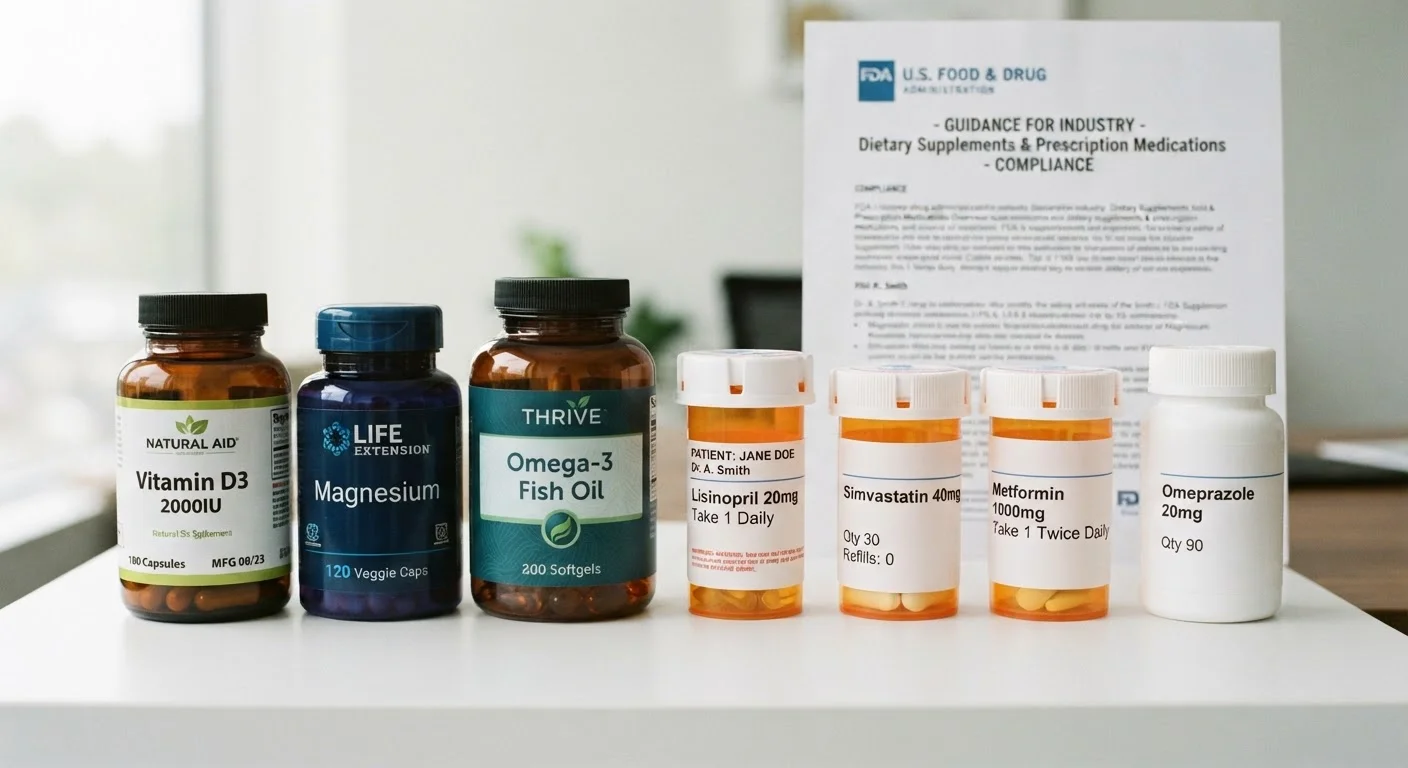
Dietary supplements - including vitamins, minerals, herbs, and protein powders - are regulated by the U.S. Food and Drug Administration (FDA), but under a separate and less stringent framework than prescription or over-the-counter drugs. Manufacturers do not need to prove a supplement is safe or effective before selling it. The FDA's role is largely to monitor the market after products are already available to consumers.
The primary governing law is the Dietary Supplement Health and Education Act of 1994 (DSHEA), which shifted the burden of proof from manufacturers to the FDA - meaning the agency must demonstrate a product is unsafe rather than requiring manufacturers to demonstrate it is safe before sale.
Two Very Different Pathways to Your Medicine Cabinet
When a pharmaceutical company wants to bring a new drug to market, it must conduct years of clinical trials, submit extensive safety and efficacy data, and receive explicit FDA approval before a single pill can be sold. That process can take a decade or more and cost hundreds of millions of dollars.
Dietary supplements - vitamins, minerals, botanicals, amino acids, enzymes, and similar products - operate under an entirely different set of rules. Under the Dietary Supplement Health and Education Act of 1994 (DSHEA), manufacturers can bring supplements to market without seeking FDA approval first. They are expected to ensure their products are safe, but the agency does not review or verify that before the product reaches consumers.
This is not a loophole - it's the intended design of the law, which treats supplements as closer to food than to medicine. Understanding this framework helps explain why the supplement aisle looks the way it does, and why approaching it with informed skepticism is reasonable.
Supplements Are Not Drugs - Legally or Scientifically
The FDA defines dietary supplements as a distinct product category separate from both foods and drugs. This classification has major consequences: it determines what claims can be made, what testing is required, and how the agency oversees the market. If a supplement were marketed to treat or cure a disease, it would legally become a drug and face the full drug approval process.
What Manufacturers Are - and Aren't - Required to Do
Supplement manufacturers must follow FDA current Good Manufacturing Practices (cGMPs), a set of quality control standards covering how products are prepared, packaged, and stored. These rules are meant to ensure consistency and prevent contamination, but they do not require proof that a product works as advertised.
Manufacturers are also required to report serious adverse events to the FDA within 15 days. However, voluntary consumer reporting through MedWatch - the FDA's safety reporting program - is underused, meaning the agency's picture of real-world supplement harms may be incomplete.
Label claims are another regulated area. Supplements may include structure/function claims - statements like "supports immune health" or "promotes bone strength" - without prior FDA sign-off. However, they must include a disclaimer stating the product has not been evaluated by the FDA and is not intended to diagnose, treat, cure, or prevent any disease. Disease claims, such as "treats arthritis," are prohibited and would reclassify the product as a drug.
For a closer look at how these label rules play out in practice, see how to read a supplement label before you open the bottle.
How the FDA Steps In After the Fact
Because pre-market approval is not required, the FDA's primary enforcement role with supplements is reactive. The agency monitors the market through adverse event reports, inspections of manufacturing facilities, and surveillance of label claims. If a product is found to be unsafe, adulterated, or misbranded, the FDA can issue warning letters, request recalls, or pursue legal action.
Notable examples include FDA actions against products found to contain undisclosed pharmaceutical ingredients - particularly in weight loss, bodybuilding, and sexual enhancement supplements. These cases illustrate a genuine risk: some products sold as supplements have contained active drug compounds not listed on the label.
Look for Third-Party Certification Seals
When choosing a supplement, look for seals from independent organizations such as USP, NSF International, or ConsumerLab. These indicate the product has been tested for label accuracy and purity - something FDA pre-market review does not provide. Certification doesn't guarantee a supplement will work, but it reduces the risk of getting something different from what's on the label.
This post-market model differs fundamentally from the drug approval process, where the burden of proof falls on the manufacturer before any product reaches consumers. With supplements, the burden effectively shifts to the FDA to prove harm after it occurs.
Filling the Gap: Third-Party Testing and Informed Choices
Because regulatory oversight is limited before a supplement reaches shelves, a voluntary system of independent verification has developed. Organizations such as USP, NSF International, and ConsumerLab test supplements and certify that products contain what their labels claim, in the stated amounts, and without unsafe levels of contaminants. These seals don't guarantee effectiveness, but they add meaningful accountability.
Being an informed supplement consumer also means understanding interactions. Some supplements affect how the body absorbs or metabolizes prescription medications - a topic worth reviewing with your doctor. Our article on supplements and medication interactions covers common combinations that raise red flags.
Before adding anything new to your routine, a checklist of safety questions can help you evaluate what you're considering. And if you're wondering whether a supplement is even necessary, how food compares to supplements as a nutrient source is a useful starting point.
This article is for general informational purposes only and does not constitute medical advice. Consult a qualified healthcare provider before starting, stopping, or changing any supplement or medication.