

Key Takeaways
Why Supplement Labels Deserve More Attention
Americans spend billions of dollars annually on dietary supplements, yet the information printed on those bottles remains genuinely confusing to most people. Unlike prescription drugs, supplements are not reviewed by the FDA for safety or effectiveness before they go on sale. That regulatory gap places more responsibility on the consumer - which means understanding how to read a label is not just a nice skill to have, it is a practical health matter.
The good news is that once you know what each section of the label is actually communicating, the noise clears quickly. The Supplement Facts panel, serving size, %DV figures, and claims each follow defined rules, and recognizing those rules helps you cut through marketing language and focus on what the data actually shows. This article is general health information and is not a substitute for advice from a qualified healthcare professional.
Cross-Check With a Whole-Food Baseline
Before assuming you need a supplement, it helps to understand what nutrients your diet already provides. Our guide on whole foods versus supplements explains when dietary sources are likely sufficient and when a supplement may genuinely fill a gap.
What to Look for - Step by Step
Use the steps below the next time you pick up a supplement. You will need the product itself and, optionally, a reliable reference like the NIH Office of Dietary Supplements to cross-check nutrient information.
What you will need
The supplement bottle itself
The primary source of label information you will be reading and evaluating.
NIH Office of Dietary Supplements website (ods.od.nih.gov)
A free, authoritative reference for verifying nutrient functions and understanding established intake levels.
Third-party certification databases (e.g., NSF, USP)
Used to verify whether a product has been independently tested for label accuracy and purity.
Find the Supplement Facts Panel
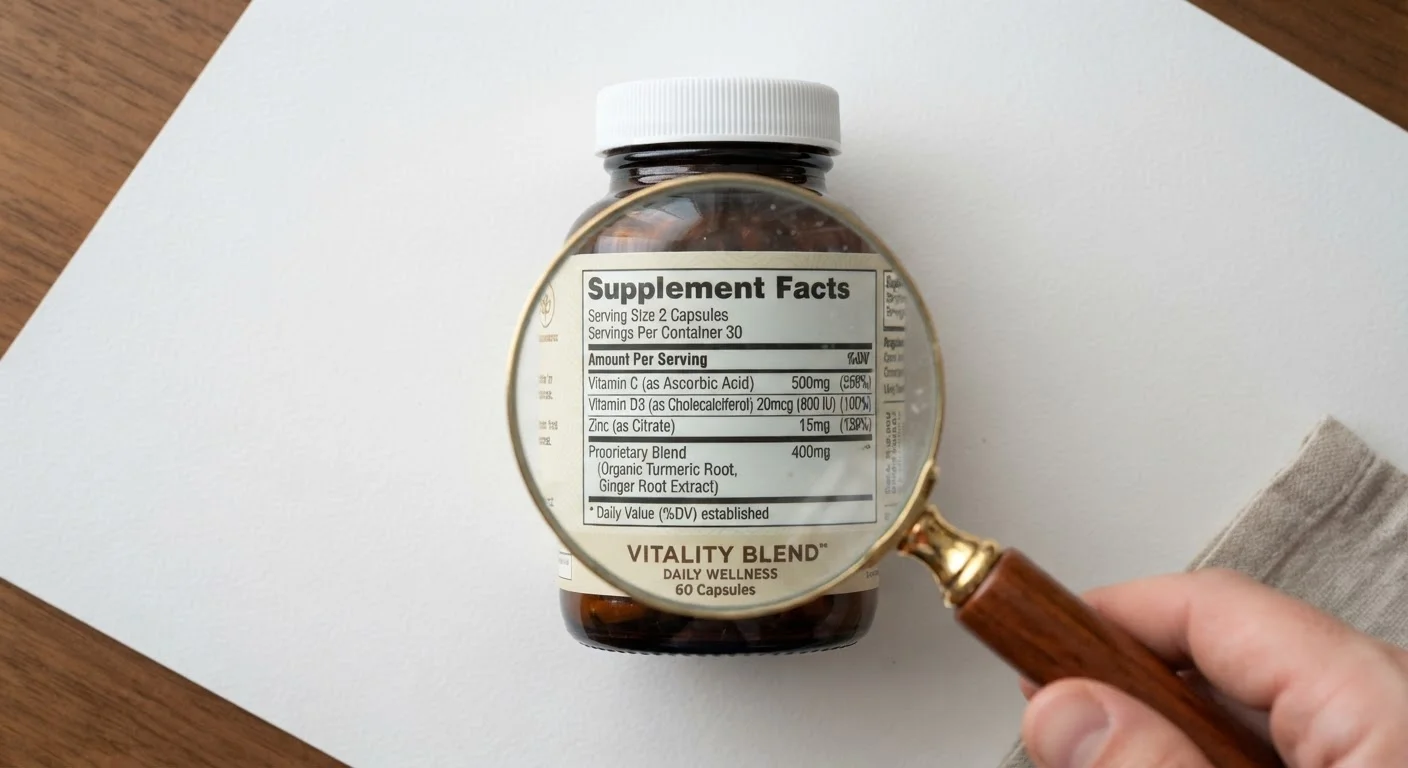
Every legal dietary supplement sold in the United States must carry a Supplement Facts panel - the nutritional information box regulated by the FDA. It is distinct from a standard Nutrition Facts label found on food. Look for it on the back or side of the container. Everything else on the label - health claims, marketing language, imagery - is secondary to what this panel tells you.
Identify the Serving Size and Servings Per Container
At the top of the Supplement Facts panel, you will find the serving size - this might be one capsule, two tablets, one scoop, or something else entirely. Every number on the rest of the label corresponds to this amount, not the full bottle. Directly below, servings per container tells you how many doses you are actually getting. Multiply these two figures together to understand how long the product will last.
Read Each Nutrient and Its Amount
The body of the panel lists each ingredient, its amount per serving (in milligrams, micrograms, IU, or other units), and its % Daily Value (%DV) where applicable. The %DV reflects how much of a nutrient one serving provides relative to a general reference intake for a 2,000-calorie diet - a population-level baseline, not a personal prescription. Some nutrients, particularly herbal extracts, will show a dash (-) in the %DV column because no established daily reference value exists for them.
For a deeper look at how %DV works across packaged foods, see what the Nutrition Facts label is actually telling you.
Scrutinize Any Proprietary Blends
Some products group multiple ingredients under a single proprietary blend name, listing only the total combined weight of the blend rather than individual amounts. While this practice is legal, it prevents you from knowing whether each component is present in a meaningful dose. Ingredients within a blend must still be listed in descending order by weight, so the first ingredient is the most abundant - but you still cannot tell by how much.
[warning_callout]Review the Other Ingredients List
Below the Supplement Facts panel, manufacturers must list other ingredients - fillers, binders, coatings, colorants, and preservatives used in the manufacturing process. Common examples include cellulose (a plant-based capsule material), silicon dioxide (an anti-caking agent), and various dyes. If you have allergies, sensitivities, or dietary restrictions - for example, avoiding gelatin, gluten, or certain dyes - this section is essential reading.
Evaluate Any Health Claims on the Label
Supplement labels may include one of several types of regulated claims. A structure/function claim - the most common type - describes how an ingredient may support a normal body function (e.g., 'supports immune health'). These claims do not require FDA approval, but the manufacturer must notify the FDA and include a disclaimer stating the claim has not been evaluated by the FDA and that the product is not intended to diagnose, treat, cure, or prevent any disease. Look for that disclaimer - its absence is a compliance problem. Be skeptical of language that sounds like a disease treatment claim, which is held to a much higher regulatory standard.
Look for Third-Party Certification Seals
Because supplements are not pre-approved for safety or potency, independent organizations such as NSF International, the U.S. Pharmacopeia (USP), and ConsumerLab offer voluntary testing and certification programs. A seal from one of these organizations indicates the product was tested to verify that it contains what the label claims, in the stated amounts, and is free from specified contaminants. It does not confirm that the supplement will produce any particular health effect. For more guidance on evaluating supplement quality before purchasing, see our supplement safety checklist.
Supplements Are Not FDA Pre-Approved
Unlike prescription medications, dietary supplements do not require FDA approval before they reach store shelves. The FDA regulates supplements under a different framework than drugs, meaning the burden of proving safety largely falls on the manufacturer after a product is already on the market. This makes your ability to critically read a label - and ask the right questions - especially important.
Putting It All Together
Reading a supplement label well takes about five minutes once you know where to look. Start with the Supplement Facts panel and serving size, move through the nutrient list and any blends with a critical eye, and then check the other ingredients and any claims. If a label makes it difficult to find basic information - quantities, ingredients, required disclaimers - treat that as meaningful data about the product.
Understanding what is on the label is only part of the picture. Our vitamin and mineral reference guide can help you understand what each nutrient does and where it naturally appears in food. And if you take or are considering omega-3s specifically, the omega-3 plain-language breakdown covers how EPA, DHA, and ALA differ - information that becomes much more useful once you can read the label accurately.
This article is for general informational purposes only and does not constitute medical advice. Always consult a qualified healthcare professional before starting, stopping, or changing any supplement or health routine.