

Key Takeaways
Start here
Why Knife Skills Matter More Than You Think
Next
The Right Grip and Stance
Build on it
Essential Cuts to Know
Keep it up
Keeping Your Knife Safe and Sharp
Why Knife Skills Matter More Than You Think
Most home cooks underestimate how much time they spend on prep. Chopping, slicing, and dicing can easily account for half the work of any meal - and when that work feels slow or uncertain, cooking starts to feel like a chore. Learning a handful of core knife techniques changes that equation entirely.
Good knife skills aren't about speed, at least not at first. They're about consistency and safety. Uniform pieces cook evenly, which means fewer overcooked edges or raw centers. And controlled, deliberate cuts are simply safer than hurried, imprecise ones. Once these habits are established, speed follows naturally.
If you're also working on reading a recipe before you start cooking, you'll notice that understanding what a recipe means by "diced" or "julienned" before you pick up the knife makes the whole process smoother. Knife skills and recipe literacy reinforce each other.
The Right Grip and Stance
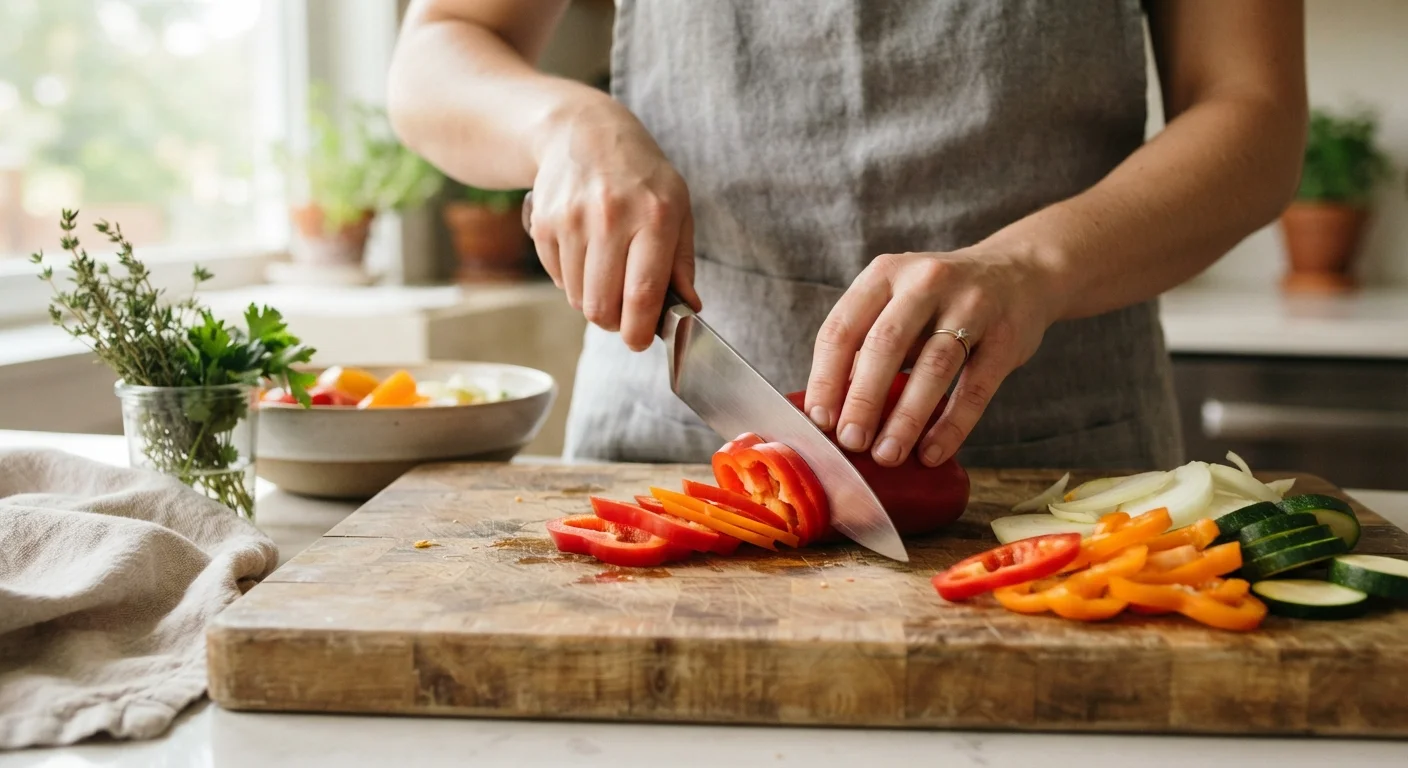
Before making a single cut, get your grip right. The most reliable hold is the pinch grip: place your thumb on one side of the blade and the side of your bent index finger on the other, just above where the blade meets the handle. Your remaining three fingers wrap around the handle. This may feel awkward at first, but it gives you significantly more blade control than a standard handle-only grip.
Your other hand - the one holding the food - should form a claw shape: fingertips curled under, knuckles forward. The flat of the blade rests lightly against your knuckles as you work, and they guide the cut while keeping your fingertips out of reach.
Body position matters too. Stand squarely in front of your cutting board with your feet roughly hip-width apart. The board itself should be stable - place a damp kitchen towel or a rubber mat underneath it to prevent sliding. See our article on kitchen equipment that earns its counter space for guidance on choosing a board that suits your setup.
Practice on a Forgiving Vegetable
When learning new cuts, start with something like a zucchini or a peeled potato - firm enough to hold its shape but forgiving if your knife angle isn't perfect. Onions and carrots come later, once your claw hand and grip feel natural. Repetition on simple ingredients builds the muscle memory that makes harder prep feel easy.
Essential Cuts to Know
Most recipes call for one of just a few cuts. Mastering these covers the vast majority of everyday prep.
Slice
A simple cross-cut through food. The key is keeping a consistent thickness throughout - this is where your claw hand earns its keep. Use a rocking or push-cut motion depending on what feels natural and what the food requires.
Dice
Dicing produces uniform cubes. Start by cutting the food into planks, then into sticks, then cross-cutting into cubes. Small dice is roughly 1/4 inch; medium is 1/2 inch; large is 3/4 inch. The exact size matters less than consistency across all pieces.
Julienne
Cut the food into planks about 1/8 inch thick, stack them, then cut lengthwise into matchstick strips. Julienned vegetables cook quickly and evenly, which makes this cut a staple for stir-fries and slaws.
Chiffonade
Used for leafy herbs and greens. Stack the leaves, roll them into a tight cylinder, and slice crosswise into thin ribbons. This technique is ideal for basil or mint, and it's much faster than picking leaves apart. If you grow or buy fresh herbs regularly, pairing this skill with proper herb storage means less waste.
Mince
After rough-chopping, rock the knife back and forth over the pile - tip of the blade on the board, handle raising and lowering - until the pieces are very fine. Essential for garlic, ginger, and fresh herbs going into sauces.
Pinch grip
A knife-holding method where you pinch the blade itself between thumb and index finger just above the handle, giving maximum control and stability.
Claw hand
A protective hand position for the hand holding food: fingertips curl under so knuckles face the blade, acting as a safe guide.
Julienne
A cutting technique that produces thin, uniform matchstick-shaped strips, typically around 1/8 inch wide and 2-3 inches long.
Chiffonade
A technique for leafy greens or herbs: stack the leaves, roll them tightly, then slice crosswise into thin ribbons.
Honing
The act of realigning a knife's edge using a honing rod or steel - it doesn't remove metal but keeps the blade performing between sharpenings.
Mise en place
A French culinary term meaning 'everything in its place' - the practice of prepping and organizing all ingredients before you begin cooking.
Keeping Your Knife Safe and Sharp
A sharp knife is a safer knife. Dull blades require more downward force, which makes them more likely to slip. Hone your knife regularly with a honing steel or rod, and have it professionally sharpened - or use a whetstone yourself - when honing no longer restores its edge.
Never Cut Toward Yourself
Always direct the knife blade away from your body, regardless of the task. Even experienced cooks can lose focus; cutting away from yourself means a slip doesn't become an injury. When breaking down food that requires pulling a blade - such as splitting a squash - place the item on a stable surface and reposition rather than pulling the knife toward you.
After each session, hand-wash your knives rather than putting them in the dishwasher. The high heat, jostling, and harsh detergents of a dishwasher accelerate dulling and can damage handles. Dry them immediately and store them on a magnetic strip or in a blade guard - loose in a drawer is hard on both the knife and your fingers.
As your confidence grows, your knife prep will become an integrated part of how you approach a whole meal. The practice of getting everything ready before cooking - what professional kitchens call mise en place - becomes much more achievable once prepping ingredients feels fast and natural rather than tedious.
Knife Sharpening vs. Honing
These two terms are often confused but mean different things. Honing realigns the blade's edge and should be done regularly - many cooks do it before every session. Sharpening actually removes metal to reshape a worn edge and is needed far less often. Treating them as the same task can lead to over-sharpening and a shorter knife lifespan.