

Key Takeaways
Why Most Kitchens Are Overcrowded
The average American kitchen holds dozens of cooking tools, yet most home cooks rely on the same handful every single day. The rest occupies drawer space, cabinet shelves, and precious counter real estate - purchased during an optimistic moment at a kitchen store or received as a well-meaning gift.
This guide cuts through the clutter. The tools below consistently prove their worth across a wide range of everyday cooking tasks. Whether you're a beginner building your first kitchen setup or a casual cook looking to simplify, these are the pieces that genuinely pull their weight - and understanding why each one matters helps you make smarter decisions about everything else. Pairing good tools with solid prep habits, like the approach described in mise en place, can transform how cooking feels on a daily basis.
The One-Week Test for Any Tool
Before adding a new piece of equipment to your kitchen, ask yourself: will I reach for this at least three times in a typical week? If the honest answer is no, it probably belongs in storage - or not in your home at all. Counter space devoted to rarely-used tools is counter space you can't use for actual cooking.
The Tools That Actually Earn Their Place
An 8-Inch Chef's Knife
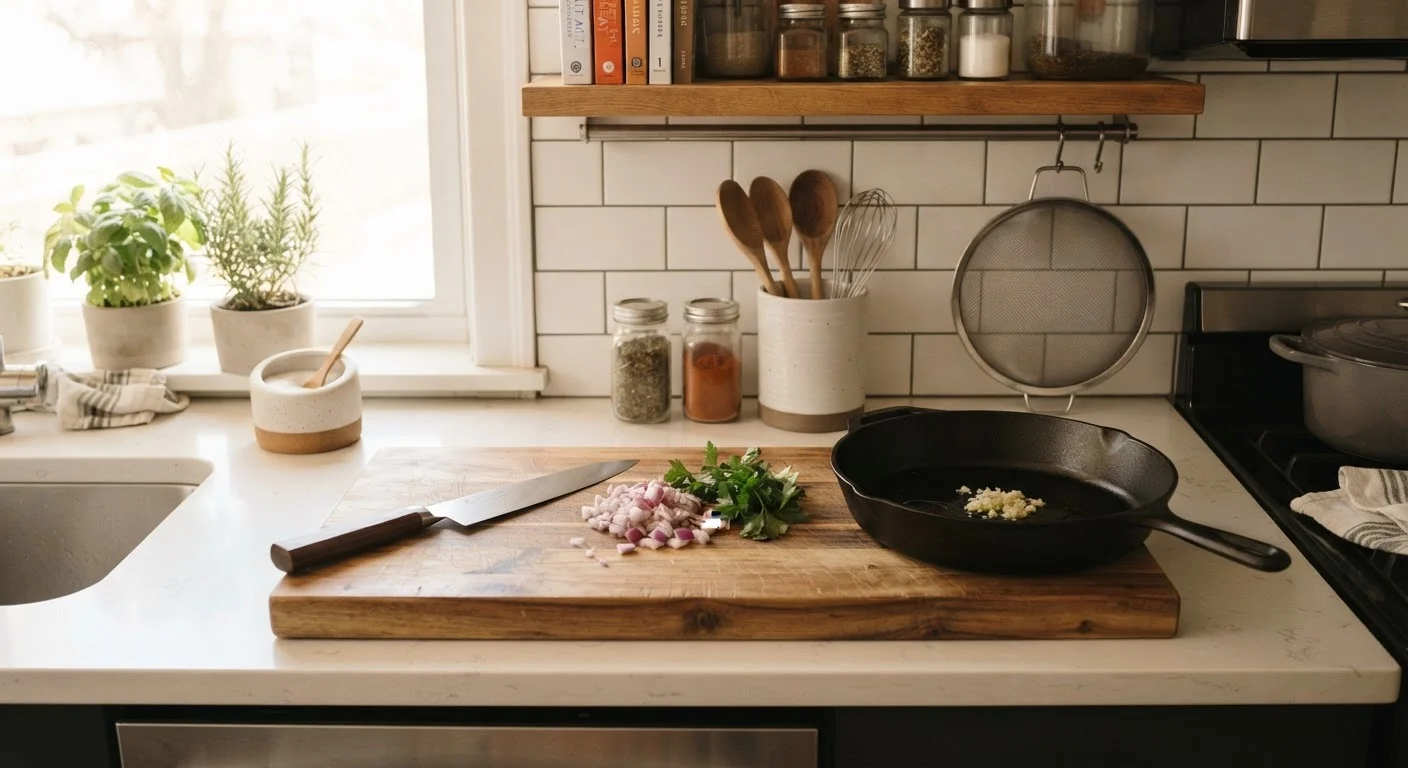
If you could keep only one kitchen tool, this would be it. A well-balanced, sharp 8-inch chef's knife handles the overwhelming majority of prep work: chopping vegetables, slicing meat, mincing garlic, and breaking down herbs. It replaces a sprawling collection of single-task blades.
The key word is sharp. A dull knife is both slower and more dangerous than a sharp one, because it requires more force and is more likely to slip. Learning to maintain an edge - with a honing steel for regular upkeep and occasional professional sharpening - extends the knife's usefulness dramatically. For building real confidence with this tool, see foundational knife techniques.
A sharp 8-inch chef's knife replaces a dozen single-purpose blades - and makes prep faster and safer.
A Large Wooden or Composite Cutting Board
Size matters here. A cutting board that's too small forces you to work in cramped quarters, which slows prep and increases the chance of food sliding off the edge. A board measuring at least 12 by 18 inches gives you room to work comfortably.
Wood and composite boards are gentler on knife edges than glass or hard plastic alternatives, which dull blades quickly. A board with rubber feet or a damp towel underneath prevents sliding - a simple safety habit that makes a real difference.
A generously sized board with a non-slip base turns prep into a faster, safer, more organized process.
A 10- or 12-Inch Cast Iron or Heavy Stainless Skillet
A heavy skillet is the workhorse of the stovetop. It sears proteins, sautés vegetables, builds pan sauces, fries eggs, and goes from stovetop to oven without complaint. Cast iron retains heat exceptionally well and, once seasoned, develops a naturally nonstick surface over time. Heavy stainless steel offers more responsive heat control and is dishwasher safe.
Either option significantly outperforms thin, flimsy pans that create hot spots and warp under high heat. One quality skillet used consistently beats five mediocre ones every time.
One heavy, well-maintained skillet handles more cooking tasks than any other single piece of cookware.
A Dutch Oven or Heavy Lidded Pot
Braises, soups, stews, pasta water, chili, rice - a 5- to 7-quart Dutch oven or equivalent heavy pot handles all of it. The thick walls distribute heat evenly and the tight-fitting lid traps moisture, which is essential for low-and-slow cooking methods that transform tougher, less expensive cuts of meat into tender meals.
This is the tool that makes batch cooking practical. Preparing a large pot of soup or beans on a Sunday sets the stage for easier eating throughout the week - a habit explored further in strategies for eating well on a busy schedule.
A heavy lidded pot makes batch cooking practical and turns humble ingredients into genuinely satisfying meals.
A Fine-Mesh Strainer
This is the tool most home cooks don't realize they're missing until they have one. A fine-mesh strainer drains pasta and vegetables, rinses grains, strains stocks and sauces for a smoother texture, and sifts dry ingredients. It replaces the bulky colander for most tasks while doing things a colander simply cannot.
Look for a medium-sized strainer (around 6 to 8 inches in diameter) with a sturdy handle and a stable hook or rest that lets it sit across a pot or bowl hands-free. That simple feature makes it dramatically easier to use solo.
A fine-mesh strainer quietly earns its place by doing jobs that no other single tool can replicate.
An Instant-Read Thermometer
Guessing whether chicken is cooked through, or whether a steak has reached the right internal temperature, leads to either underdone food (a genuine safety concern) or overcooked, dry results. An instant-read thermometer removes the guesswork entirely.
This is one of the most affordable tools on this list, and one of the highest-impact. It builds cooking confidence quickly - once you know what properly cooked meat actually registers on a thermometer, you stop relying on unreliable visual cues. Food safety guidelines from the USDA specify minimum safe internal temperatures for different proteins, and this tool is how you reliably hit them.
An instant-read thermometer removes guesswork from cooking proteins safely and consistently every time.
What Didn't Make the List
Specialty appliances - single-serve blenders, electric can openers, avocado slicers, dedicated egg cookers - are excluded here not because they're worthless, but because they serve narrow tasks that basic techniques and core tools already handle. If a gadget genuinely gets used several times a week in your specific household, it earns its place. The goal is intentionality, not minimalism for its own sake.
Putting It All Together
Notice that none of the tools above are novelties or niche gadgets. They succeed because they handle multiple tasks reliably, day after day. A sharp chef's knife, for example, replaces the mandoline, the mezzaluna, the herb stripper, and the egg slicer - all at once. That kind of versatility is what justifies counter or cabinet space.
If you're building your kitchen from scratch on a budget, start with the highest-impact items first - typically the knife, cutting board, and a good skillet. You can add others gradually as your cooking habits become clearer. For more ideas on setting yourself up for consistent success throughout the week, the weekly prep checklist is a practical next step.