

Key Takeaways
What You'll Need Before You Start
Reading a pet food label is a skill that gets easier with practice. Before diving into the steps, it helps to understand the basic anatomy of a label and gather a few things to make the process meaningful.
What you will need
Magnifying glass or phone camera
Pet food labels often use small print; zooming in helps you read every line accurately.
AAFCO's published nutrient profiles
Free reference documents that show minimum and maximum nutrient requirements by life stage, useful for cross-checking a guaranteed analysis.
Notepad or notes app
Jot down questions for your vet as you review the label, especially if your pet has specific dietary needs.
How to Read a Pet Food Label Step by Step
Every commercially sold pet food label in the United States must comply with regulations set by the Association of American Feed Control Officials (AAFCO) and individual state feed laws. Working through the label in a structured order helps you separate genuine nutritional information from packaging noise.
Find the Product Name and Read It Carefully
The product name is regulated and reveals more than it appears to. AAFCO's 'percentage rules' govern how a named ingredient relates to its actual presence in the food. A bag labeled 'Salmon Cat Food' must contain at least 95% salmon (excluding water). A 'Salmon Entrée' needs only 25%. A 'Cat Food with Salmon' requires just 3%. The name is your first nutritional clue before you even open the bag.
Locate and Read the AAFCO Nutritional Adequacy Statement
This statement - sometimes called the 'adequacy statement' or 'nutritional adequacy claim' - is one of the most important lines on any pet food label. It will say something like: '[Product name] is formulated to meet the nutritional levels established by the AAFCO Dog Food Nutrient Profiles for all life stages.'
Look for two things: the life stage (adult maintenance, growth and reproduction, or all life stages) and the substantiation method. Foods substantiated by feeding trials have been tested on live animals. Foods 'formulated to meet' profiles are calculated to match nutrient targets but may not have undergone live testing. Neither is inherently better, but the distinction is worth knowing.
Work Through the Ingredient List
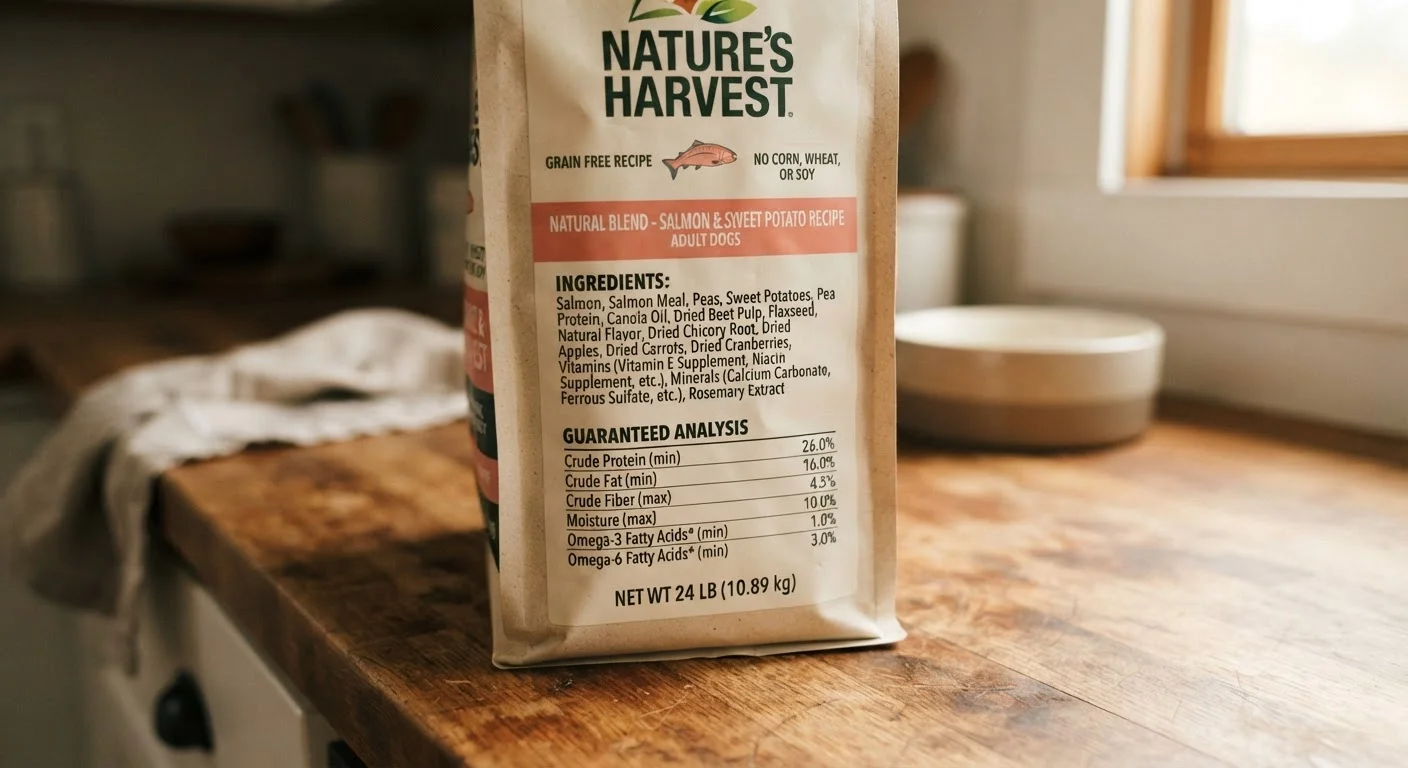
Ingredients are listed in descending order by weight before cooking. This matters because whole meats contain significant moisture (often 70-75% water), which means they weigh more before processing than after. A whole chicken listed first may contribute less actual protein than a 'chicken meal' listed third - chicken meal is a concentrated, moisture-removed ingredient.
Scan the first five to eight ingredients, as these typically make up the bulk of the formula. Look for a named protein source (e.g., 'chicken,' 'salmon,' 'beef') rather than a generic term like 'meat' or 'poultry.' Also note how carbohydrate sources (grains, legumes, potatoes) are distributed and whether any vitamin or mineral premixes appear.
Review the Guaranteed Analysis Panel
The guaranteed analysis reports four required nutrients: crude protein (minimum), crude fat (minimum), crude fiber (maximum), and moisture (maximum). Some manufacturers voluntarily list additional nutrients such as omega fatty acids, calcium, or phosphorus.
Keep in mind these are guarantees, not exact values - the actual content may be higher (for minimums) or lower (for maximums) than stated. Crude protein and fat figures also do not reflect digestibility, only total content. To compare foods that differ significantly in moisture (such as dry kibble vs. canned food), you'll need to convert values to a dry-matter basis by dividing the nutrient percentage by the percentage of dry matter in the food.
Check the Feeding Guidelines - Then Adjust
Feeding guidelines are printed on every complete and balanced pet food. They provide a general starting range based on body weight, but they are averages - developed for a theoretical average animal of that weight. Your pet's actual caloric needs depend on age, activity level, reproductive status, and individual metabolism.
Use the label guidelines as a baseline, then monitor your pet's body condition over time. For a practical framework on assessing whether your pet is at a healthy weight, see body condition scoring explained.
Dry vs. Wet: Compare on Dry-Matter Basis
Canned foods are often 75-80% moisture, while dry kibble typically contains around 10%. This makes direct guaranteed-analysis comparisons misleading. To make an apples-to-apples comparison, divide each nutrient percentage by the total dry matter percentage of the food. For more on how these formats differ nutritionally, see our comparison of dry, wet, and raw diets.
Decoding Common Label Terms
Pet food packaging uses a mix of regulated and unregulated language. Knowing the difference protects you from being swayed by terms that sound meaningful but carry little nutritional weight.
Regulated Terms
- Complete and balanced: Means the food meets AAFCO nutrient profiles for the stated life stage - this is one of the most important phrases on the label.
- Beef dinner / entrée / formula: Under AAFCO rules, a named ingredient must make up at least 25% of the product (but less than 95%) when these descriptor words appear.
- With beef: The named ingredient only needs to be 3% of the formula - a meaningful difference from 'beef dinner.'
- Beef flavor: Enough of the ingredient must be detectable, but it could be a very small amount.
- Natural: AAFCO defines this as derived from plant, animal, or mined sources without chemically synthetic processes - but it does not mean organic, unprocessed, or nutritionally superior.
Largely Unregulated Terms
- Holistic, premium, human-grade: These words have no standardized legal definition in pet food and do not signal a specific nutrient quality.
- Grain-free: Describes an ingredient absence, not a nutritional benefit. See our guide on grain-free vs. grain-inclusive diets for context on what current research says.
AAFCO Statement Absence Is a Red Flag
If a pet food has no AAFCO nutritional adequacy statement, it has not been validated to meet established minimum nutrient requirements. Feeding such a product as a sole diet over time carries a real risk of nutritional deficiency. Always look for this statement before committing to a food as your pet's primary nutrition source.
Putting It All Together
No single section of a pet food label tells the whole story. A food with a high-protein guaranteed analysis may still be lower in digestible protein than another formula - processing method, ingredient quality, and the specific animal's needs all matter. That's why the label is a starting point, not a final verdict.
If your pet has a health condition, is in a life stage with elevated needs (such as pregnancy or kittenhood), or you're managing weight concerns, label reading pairs best with a conversation with your veterinarian. For a deeper look at how body condition and nutrition intersect, see how vets assess healthy weight in pets.
For a broader foundation on daily nutrition, grooming, and care, explore our Pet Care Basics hub. And if you're curious how label-reading skills translate to other contexts, decoding human nutrition labels follows a surprisingly similar logic.
This article is for general informational purposes only and is not a substitute for veterinary advice. Always consult a licensed veterinarian for guidance specific to your pet's health and nutritional needs.