

Key Takeaways
Nutrition Facts Label
The Nutrition Facts label is the standardized panel required by the FDA on most packaged foods and beverages sold in the United States. It displays key nutritional information - including calories, macronutrients, vitamins, and minerals - based on a specific serving size. Its purpose is to help consumers understand what they're eating and how it fits into an overall daily diet.
The current label format was updated by the FDA in 2016 and phased in through 2020, with changes including a more prominent calorie display, the addition of 'added sugars,' and updated Daily Value percentages based on newer dietary research.
Start at the Top: Serving Size and Servings Per Container
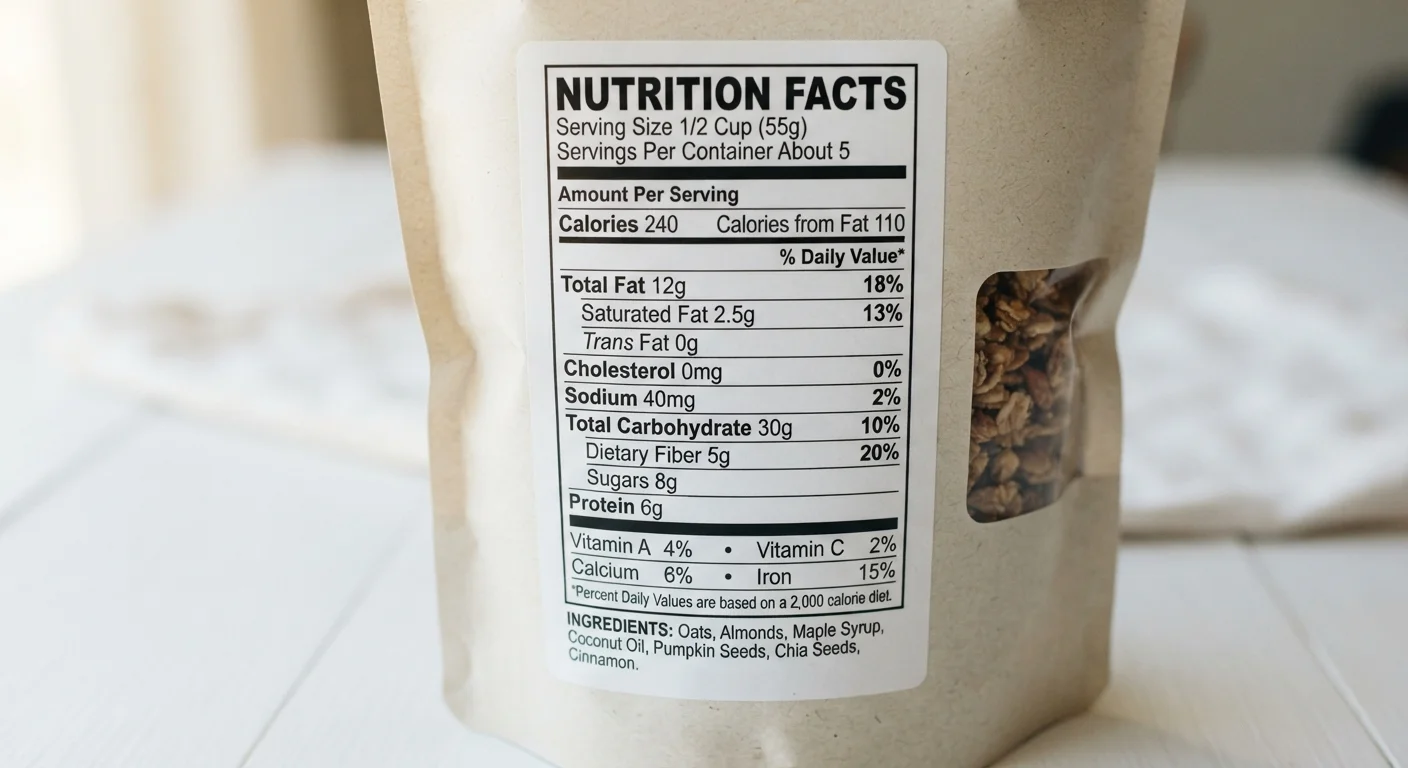
The very first line of the Nutrition Facts panel is the one most people skip - and it's the most important. Serving size defines the unit every other number on the label is calculated for. If the serving size is 1 cup and you eat 2 cups, every calorie, gram, and milligram listed doubles.
Directly below that is servings per container. A bag of chips might list 140 calories per serving, but if the bag contains 3 servings, eating the whole bag means 420 calories. This is an easy place to underestimate what you're actually consuming.
It's worth noting that serving sizes are set by the FDA to reflect typical eating amounts - they are not dietary recommendations. For a deeper look at why this distinction matters, see our explainer on serving size vs. portion size.
Check the Servings Per Container First
Before reading any other number on the label, look at how many servings the package contains. If a bottle of juice lists 2.5 servings and you drink the whole thing, multiply every value on the label by 2.5. This single habit prevents one of the most common errors in label reading.
Calories: Energy in a Single Serving
Calories measure the energy a food provides. On the updated label, the calorie count appears in large, bold type - making it the easiest number to find at a glance. This figure applies strictly to one serving, so again, quantity eaten matters.
While calories are one useful data point, they don't tell the full story of a food's nutritional value. A 200-calorie food dense in fiber, protein, and micronutrients is nutritionally different from a 200-calorie food that's mostly added sugar and refined starch. Use calories alongside the rest of the label, not in isolation.
70%+
Americans exceed recommended sodium intake daily
According to the U.S. Centers for Disease Control and Prevention, more than 70% of Americans consume more than the recommended amount of sodium each day, making sodium one of the most important nutrients to watch on the label.
17 tsp
Average daily added sugar consumption per American
The U.S. Dietary Guidelines Advisory Committee has noted that Americans consume an average of around 17 teaspoons of added sugars per day - well above the recommended limit of no more than 12 teaspoons for a 2,000-calorie diet.
Nutrients to Limit and Nutrients to Encourage
The label divides nutrients into two broad groups. The first are those most Americans consume in excess and that are linked to chronic health risks when overconsumed:
- Saturated fat - found in animal products and some tropical oils; linked to cardiovascular health concerns when consumed in high amounts.
- Sodium - essential in small quantities but consumed far above recommended levels by most Americans; connected to blood pressure concerns.
- Added sugars - sweeteners added during food manufacturing, distinct from naturally occurring sugars in fruit or dairy.
The second group includes nutrients that many Americans don't get enough of:
- Dietary fiber - supports digestive health and is associated with better blood sugar regulation.
- Vitamin D, calcium, iron, and potassium - highlighted because deficiencies are common across the U.S. population.
The label doesn't make value judgments for you, but these groupings reflect current public health guidance on where most people's diets fall short or go overboard.
Understanding % Daily Value
% Daily Value (% DV) is the label's built-in comparison tool. It tells you what percentage of a nutrient's recommended daily intake one serving provides, based on a 2,000-calorie-per-day reference diet. That calorie level is a general benchmark - your actual needs may differ based on age, sex, activity level, and health status.
The FDA offers a simple rule of thumb: 5% DV or less means a food is low in that nutrient; 20% DV or more means it's high. Use this to quickly flag a soup that delivers 40% of your daily sodium in a single bowl, or a fortified cereal that provides 25% of your daily iron.
% DV is especially useful for comparing similar products side by side. Because it's standardized, you can use it to choose the pasta sauce lower in sodium or the yogurt higher in calcium without doing any math.
% DV Is Based on a General Reference Diet
The 2,000-calorie daily diet used to calculate % Daily Values is a standardized benchmark, not a prescription for how much anyone should eat. Individual calorie and nutrient needs vary based on age, body size, activity level, and health conditions. Think of % DV as a relative compass, not an absolute target. A registered dietitian can help you understand what daily intake targets make sense for your specific situation.
The Footnote, Ingredients, and What Comes Next
At the bottom of the Nutrition Facts panel, a small footnote explains that % DVs are based on a 2,000-calorie diet. This is a legal standardization requirement, not a personal recommendation - it simply anchors the percentages to a common reference point.
The ingredient list, which appears separately from the Nutrition Facts panel, is also worth scanning. Ingredients are listed in descending order by weight, so the first few items are the dominant components. If added sugars (under any of their many names - corn syrup, dextrose, evaporated cane juice) appear near the top, the product is heavily sweetened.
Once you understand how to read a food label, the same analytical thinking applies in other contexts. If you're curious how these skills translate when eating out, our guide to reading a menu nutritionally walks through what to look for at restaurants. And if you've ever wondered how supplement labels compare to food labels, the supplement label guide covers the key differences.
This article is for general informational purposes only and is not a substitute for personalized dietary or medical advice. Consult a registered dietitian or qualified healthcare professional for guidance tailored to your individual health needs.