

Key Takeaways
Serving Size vs. Portion Size
A serving size is a standardized reference amount printed on a food's nutrition facts label - set by regulators to help consumers compare foods. A portion size is simply how much you actually eat in one sitting. These two numbers can be very different, and confusing them leads to inaccurate estimates of calorie and nutrient intake.
The FDA requires serving sizes on Nutrition Facts labels to reflect amounts typically consumed at one eating occasion, based on food consumption surveys - not dietary recommendations.
Two Different Concepts That Are Easy to Conflate
Pick up almost any packaged food and you'll see a Nutrition Facts label listing a serving size at the top. Many people assume that number tells them how much to eat. It doesn't - it tells you how much the label's nutrition information is based on.
The serving size is a standardized unit set by the U.S. Food and Drug Administration (FDA). It's designed to help consumers make apples-to-apples comparisons between similar products. The portion size, on the other hand, is whatever amount ends up on your plate or in your bowl. That's entirely up to you - and it rarely matches the label exactly.
This distinction matters because every number on a nutrition label - calories, fat, sodium, sugar - applies only to one labeled serving. Eat two servings, and you've doubled every figure. Eat half a serving, and you've halved them. When you don't account for the gap between what the label describes and what you actually ate, your sense of your intake can be significantly off.
Serving Sizes Were Updated in 2020
The FDA updated Nutrition Facts label requirements, which went into full effect for most manufacturers in 2020. Serving sizes for many foods were revised to better reflect how much people actually eat at one time - for example, ice cream serving sizes moved from ½ cup to ⅔ cup. Even so, your actual portion may still differ substantially from what's listed.
Why the Gap Between Them Is Often Larger Than You Think
Research and common experience both suggest that most people eat more than a single labeled serving in one sitting - sometimes considerably more. A bag of chips might list a serving as about 1 ounce (roughly 15 chips), but it's easy to eat two or three times that amount without realizing it.
2-3x
Typical restaurant portion vs. standard serving size
Nutritional analyses of restaurant meals commonly find portions two to three times larger than comparable labeled serving sizes for the same food category.
~92%
Americans who misread nutrition labels
Research published in the Journal of the Academy of Nutrition and Dietetics found the vast majority of consumers struggle to accurately use serving size information to calculate total nutrient intake.
Restaurant meals make this even more pronounced. A pasta dish at a sit-down restaurant might contain three to four times the labeled serving size for that type of pasta. Since restaurants aren't required to display Nutrition Facts labels the same way packaged goods do, diners have less of a reference point. For guidance on navigating restaurant nutrition, see our guide to reading menus nutritionally.
Even at home, the size of your bowl, plate, or glass influences how much you pour - often more than any deliberate decision. Larger dishes tend to lead to larger portions, regardless of hunger level.
How to Use Both Numbers Together
The key is treating the serving size as a measuring unit, not a meal plan. Here's a practical approach:
- Check the serving size first. Before reading any other number on the label, note what one serving actually looks like - in grams, cups, or pieces.
- Estimate how many servings you're eating. Compare that unit to the amount you're actually consuming. If a serving is ¾ cup and you're eating 1½ cups, you're having two servings.
- Scale the numbers accordingly. Multiply calories, sodium, and other values by the number of servings you're eating. This gives you an accurate picture of your actual intake.
For a deeper look at how each part of the label works together, our article on what the Nutrition Facts label is actually telling you walks through every section in plain terms.
Weigh Your Food Once, Learn for Life
If you want a reliable sense of your portions, try using a kitchen scale to weigh a single serving of a food you eat regularly - just once. Most people find their typical pour or scoop is noticeably different from the labeled amount. This one-time exercise builds lasting intuition without requiring constant tracking.
Where This Matters Most in Everyday Eating
A few categories of food are especially worth watching:
- Snack foods and crackers: Serving sizes are often much smaller than what fits in a typical snack bowl.
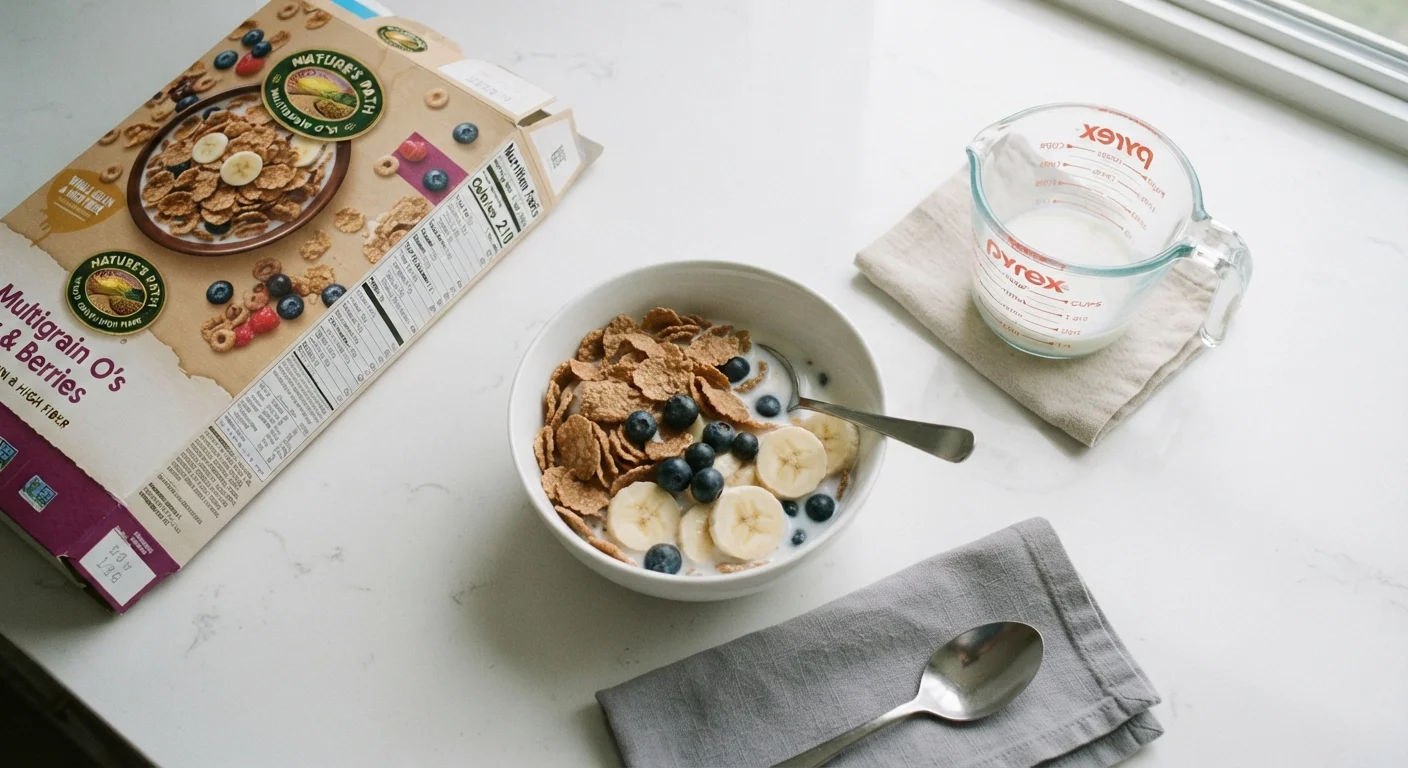
- Breakfast cereals: A labeled serving is frequently ¾ cup to 1 cup - but most people pour significantly more.
- Cooking oils and condiments: These are calorie-dense, and their labeled serving sizes (often 1 tablespoon) can be easy to exceed without noticing.
- Supplements: The same logic applies - serving size on a supplement label defines the nutrient amounts listed, and taking more or less changes your actual intake. Our guide to reading supplement labels covers this in detail.
Building awareness of portion size versus serving size isn't about rigid tracking - it's about having an accurate mental model so that nutrition information on labels is actually useful to you.