

Key Takeaways
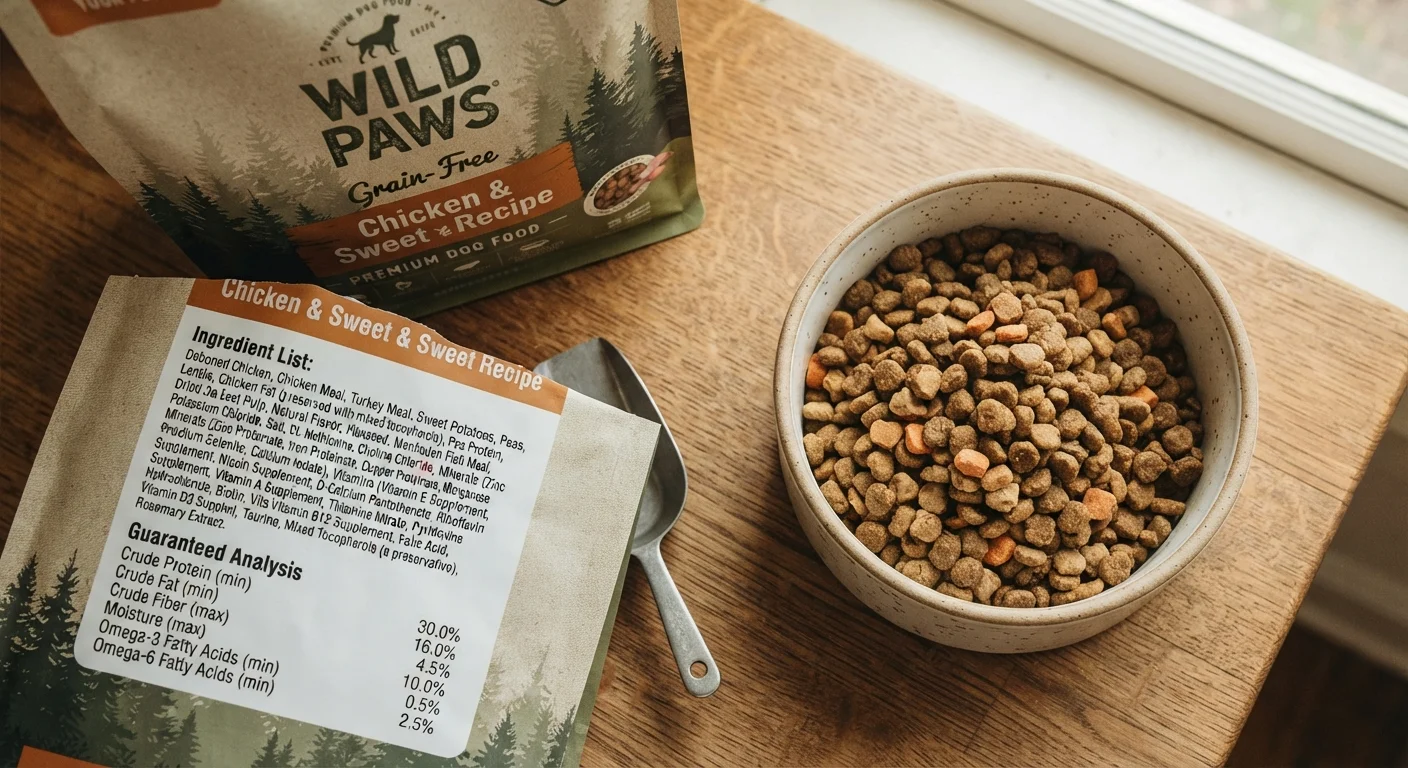
Pet Food Label
A pet food label is the regulated set of information printed on pet food packaging. It includes the ingredient list, guaranteed analysis panel, nutritional adequacy statement, and feeding guidelines - all governed by rules set at the federal and state level to give pet owners a standardized way to evaluate what they're feeding their animals.
In the U.S., pet food labeling is primarily regulated by the Association of American Feed Control Officials (AAFCO), whose model regulations most states adopt. The FDA also oversees safety requirements under the Federal Food, Drug, and Cosmetic Act.
The Five Required Elements on Every Label
Before diving into the fine print, it helps to know what the law actually requires. AAFCO's model regulations - adopted by most U.S. states - mandate five core elements on every pet food package: the product name, the net quantity statement, the manufacturer's name and address, the ingredient list, and the guaranteed analysis panel. A sixth element, the nutritional adequacy statement, is effectively required for any food claiming to be complete and balanced.
Each of these sections tells you something different. Together, they give you a reasonably full picture of what's in the bag - if you know how to read them.
Regulation Varies by State
While AAFCO sets model regulations, pet food is formally regulated at the state level, and not every state adopts every AAFCO guideline uniformly. The FDA oversees safety under federal food law. In practice, most commercially available pet foods in the U.S. follow AAFCO standards, but it's worth knowing that oversight involves multiple layers.
Decoding the Ingredient List
Ingredients are listed in descending order by weight before cooking or processing. This matters because meat contains significant moisture - often 70% or more - which inflates its pre-cooking weight. After the food is made, a named meat may contribute less total protein than its position on the list suggests.
This is why you'll sometimes see 'ingredient splitting' used to game the list: a manufacturer may list three forms of corn - corn, corn meal, and corn gluten meal - separately to keep each one lower on the list than if they were combined. Awareness of this practice helps you read the full list rather than stopping at ingredient number one.
Named ingredients - 'chicken,' 'salmon,' 'lamb' - are generally preferable to vague terms like 'meat' or 'animal digest' because they're more traceable. By-products aren't automatically bad; named organ meats like chicken liver are nutrient-dense. The quality signal is specificity, not the category itself.
For a deeper look at how food format affects what's in the bowl, see our guide to dry, wet, and raw diets.
What the Guaranteed Analysis Actually Guarantees
The guaranteed analysis panel lists minimum percentages of crude protein and crude fat, and maximum percentages of crude fiber and moisture. Note the direction: minimums and maximums, not exact values. A food stating '26% crude protein minimum' could legally contain more - or just barely that amount.
'Crude' refers to the testing method used, not the quality of the nutrient. Crude protein is calculated from nitrogen content and doesn't distinguish between highly digestible animal protein and less digestible plant sources.
95%
Minimum named ingredient for '[Ingredient] Food' label claim
Under AAFCO's naming rules, a product called 'Chicken Dog Food' must contain at least 95% chicken by weight, excluding water added in processing.
3%
Minimum for 'With [Ingredient]' label claim
AAFCO's '3% rule' means a label phrase like 'With Beef' only requires 3% of that ingredient - a meaningful difference from products named after the ingredient outright.
Comparing guaranteed analysis figures across wet and dry foods is tricky because moisture levels differ dramatically. Canned food may be 75-80% water, while kibble runs around 10%. To make a fair comparison, nutrients need to be evaluated on a dry matter basis - a calculation your veterinarian can help you work through if it's relevant to your pet's needs.
The AAFCO Nutritional Adequacy Statement
This small block of text - often overlooked - is one of the most meaningful parts of the label. It tells you whether the food is formulated to meet AAFCO nutrient profiles for a specific life stage, or whether it was tested through actual feeding trials.
A formulation claim reads something like: 'formulated to meet the nutritional levels established by the AAFCO Dog Food Nutrient Profiles for adult maintenance.' A feeding trial claim means animals were fed the diet under controlled conditions and maintained health markers within acceptable ranges - generally considered a higher standard.
Equally important is what life stage the claim covers. A food adequate for adult maintenance may not meet the higher nutrient demands of puppies, kittens, or pregnant animals. Foods labeled for 'all life stages' must meet the most demanding profile - that of growth and reproduction.
Match the Life Stage to Your Pet
Always confirm that the AAFCO statement on your pet's food matches their actual life stage - puppy or kitten, adult, or senior. If your pet is pregnant, nursing, or has a health condition, your veterinarian can help you determine whether a standard commercial formula is appropriate or whether a therapeutic or specialty diet is warranted.
If a label says 'for intermittent or supplemental feeding only,' the food is not nutritionally complete on its own. It should not be a pet's sole diet.
Marketing Language vs. Regulated Terms
Words like 'premium,' 'holistic,' 'natural,' and 'human-grade' sound meaningful but carry limited or no regulatory definition in pet food. AAFCO defines 'natural' - ingredients cannot be chemically synthesized - but doesn't regulate 'holistic' at all. 'Human-grade' has a specific legal meaning under food manufacturing law, but its use on pet food labels is not consistently enforced.
Product names do follow stricter rules. If a product is called 'Chicken Dog Food,' chicken must make up at least 95% of the total ingredients (excluding water). 'Chicken Dinner' or 'Chicken Entrée' requires only 25%. 'With Chicken' means at least 3%. These naming rules, sometimes called the 95%, 25%, and 3% rules, give you a real signal about how much of a named ingredient is actually in the food.
You can think of label reading as a layered skill - the same habits that help you decode a human nutrition label apply in a related way here. Understanding how nutrition labels work for people can sharpen your eye for the same patterns on pet food packaging.
For context on one of the more debated formulation questions, our overview of grain-free vs. grain-inclusive diets walks through what the current research does and doesn't support.
This article is for general informational purposes only and is not veterinary advice. For guidance specific to your pet's health and nutritional needs, consult a licensed veterinarian.