

Key Takeaways
Option A
Free-Feeding
The always-available, low-maintenance approach.
Best for: Independent cats, multi-pet households where competition is low, and owners with unpredictable schedules.
Option B
Measured Meals
The structured, portion-controlled method.
Best for: Dogs, weight-prone pets, multi-pet homes with food competition, and owners who want close monitoring of appetite.
If you have a healthy adult cat who self-regulates well
Free-Feeding
Cats evolved as grazers and some naturally pace themselves with dry kibble. Constant access can reduce food-related anxiety in low-competition single-cat homes.
If your pet is overweight or prone to weight gain
Measured Meals
Portion control is the most direct tool for managing caloric intake. Your vet can help set a daily target based on your pet's body condition score.
If you have multiple pets with different dietary needs
Measured Meals
Scheduled feeding allows you to separate pets at mealtimes, ensuring each animal eats its own food in the right amount.
If you have a dog of any age or breed
Measured Meals
Most dogs lack the instinct to self-regulate food intake and will eat whatever is available, making portion control essential for long-term health.
If your schedule is highly unpredictable and you feed only dry kibble to a single cat
Free-Feeding
For a self-regulating cat on dry food, free-feeding can reduce missed meals and feeding-time stress when your routine varies significantly.
What Each Method Actually Means
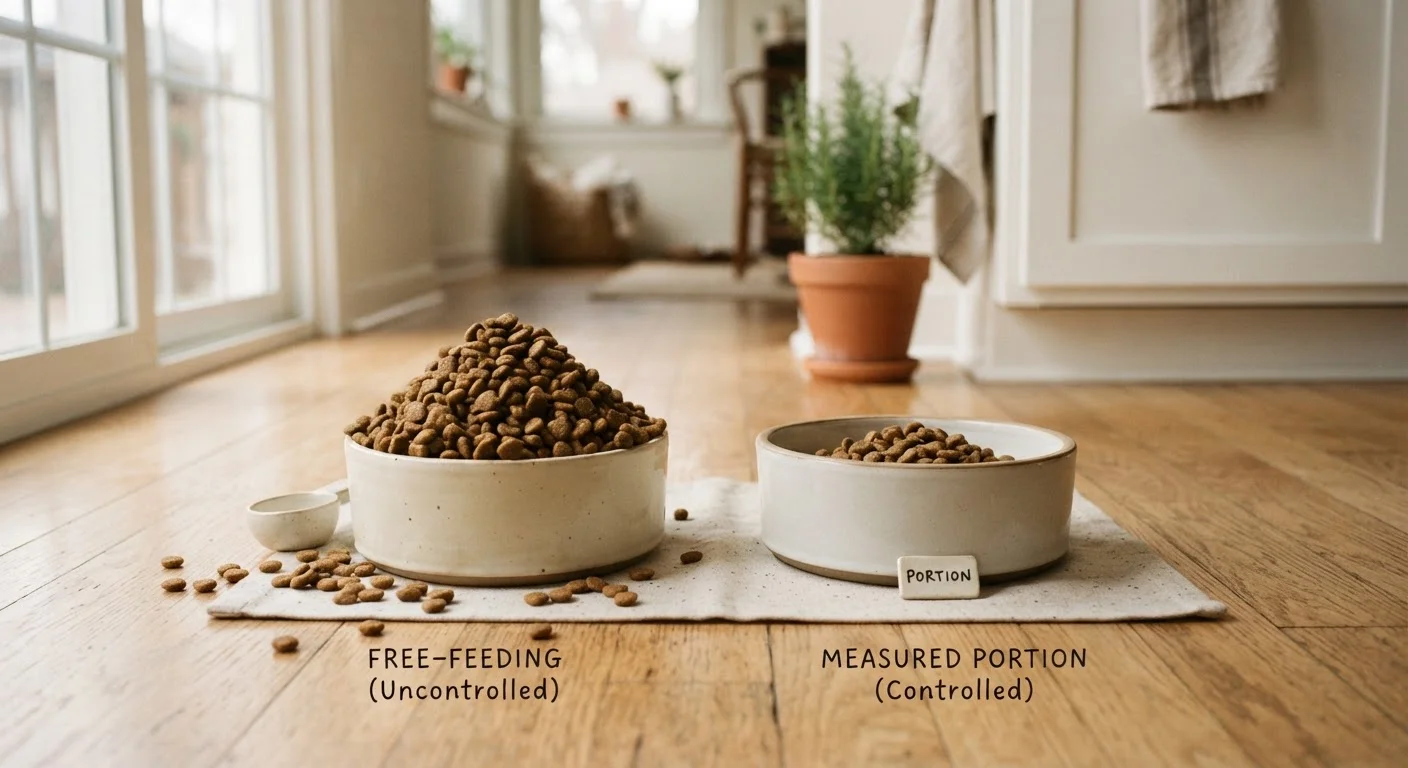
Free-feeding means filling a bowl with food and leaving it available at all times, allowing the pet to eat whenever they choose. Measured meals means offering a specific, pre-weighed or measured portion at set times - typically once or twice daily - and removing any uneaten food after a defined window.
Neither approach is universally right or wrong. The best fit depends on your pet's species, age, health, and your household setup. For a deeper look at how food type factors into this decision, see our guide on dry food, wet food, and raw diets.
| Criterion | Free-Feeding | Measured Meals |
|---|---|---|
| Portion control | None - pet self-regulates | Precise - owner controls intake |
| Best species fit | Some adult cats | Dogs, most cats, all life stages |
| Appetite monitoring | Difficult to track | Easy to observe daily |
| Food type compatibility | Dry kibble only | All food types |
| Multi-pet suitability | Challenging with competition | Easier to manage separately |
| Owner time investment | Low | Moderate - set schedule required |
| Weight management support | Poor | Strong |
The Case for Free-Feeding
Free-feeding is most commonly practiced with dry kibble for cats. Because kibble doesn't spoil quickly at room temperature, it can safely sit in a bowl for several hours. Some cats genuinely benefit from grazing - eating small amounts frequently throughout the day - which more closely mirrors their natural hunting behavior.
It also reduces feeding-time anxiety in calm single-cat households, and it's lower-effort for owners. If you're balancing a demanding schedule, this flexibility can matter. That said, even cats who seem like good candidates should be weighed regularly to confirm they're not gradually gaining.
Key limitation: Wet food, raw food, and homemade diets should never be free-fed. These spoil within a few hours and can cause foodborne illness. Free-feeding also makes it harder to notice when a pet's appetite has decreased - an early sign of illness.
The Case for Measured Meals
Measured meals offer a level of control that free-feeding simply cannot. When you know exactly how much food went into the bowl and how much came back out, you have a daily record of your pet's appetite - one of the earliest and most reliable health signals available to owners.
This method is strongly preferred for dogs. Canine physiology and behavior mean most dogs will continue eating past the point of fullness, making owner-controlled portions essential. It's also the standard recommendation for pets managing weight concerns. Our companion article on managing a pet's weight explains how vets assess body condition and why gradual change matters.
~60%
Estimated US pets that are overweight or obese
According to the Association for Pet Obesity Prevention, a significant majority of American dogs and cats are assessed as overweight or obese in annual clinical surveys.
2×
Meals per day recommended for most adult dogs
Most veterinary nutritionists recommend feeding adult dogs twice daily rather than once, to support digestion and stable energy levels.
In multi-pet homes, scheduled feeding enables separation at mealtimes - critical when pets have different dietary needs or when one animal tends to guard food. It also builds a routine, which many pets find calming and predictable.
For first-time owners building daily care habits, our broader guide The New Pet Owner's Foundation covers how feeding schedules fit into a healthy overall routine.
How to Choose - and When to Reassess
Start with your pet's species and life stage. Puppies and kittens generally need more frequent, measured meals to support growth. Senior pets may have changing caloric needs that make portion tracking especially important. Pets with health conditions - diabetes, kidney disease, food allergies - almost always require structured feeding as part of their management plan.
If you're currently free-feeding and wondering whether a change is warranted, look for these signs: gradual weight gain, difficulty distinguishing individual appetites in a multi-pet home, or a pet who seems to eat out of boredom rather than hunger.
When to Involve Your Veterinarian
If your pet is gaining weight, seems uninterested in meals, or has been diagnosed with a health condition, discuss feeding method and portion size with your vet before making changes. Body condition scoring - a hands-on assessment vets use to evaluate fat coverage and muscle mass - is more informative than weight alone. Your vet can also calculate a caloric target specific to your pet's size, age, and activity level.
Whatever method you use, the food itself matters enormously. Our article on grain-free vs. grain-inclusive pet diets walks through what current research says and what questions to raise with your vet.
This article provides general educational information about pet feeding approaches and is not a substitute for personalized advice from a licensed veterinarian. Always consult your vet before making significant changes to your pet's diet or feeding routine.