

| Smoke detector test frequency | Monthly (using test button) (U.S. Fire Administration general guidance) |
| Smoke detector lifespan | ~10 years from manufacture date (National Fire Protection Association (NFPA)) |
| CO alarm lifespan | 5-7 years (check label) (Consumer Product Safety Commission general guidance) |
| Fire extinguisher inspection | Monthly visual + annual professional check (NFPA 10 standard) |
| Detectors required per home | Every level, inside and outside all sleeping areas (NFPA 72 National Fire Alarm Code) |
| After extinguisher discharge | Recharge or replace immediately |
Why Maintenance Is the Whole Point
Smoke detectors, carbon monoxide (CO) alarms, and fire extinguishers don't fail dramatically - they fail quietly. A detector with a dead battery or a decade-old sensor simply won't alert you when it counts. The good news: keeping these devices in working order takes very little time if you build it into a regular routine.
This guide covers what to test, when to replace, and where each device should be installed, so you can quickly confirm your home meets current safety standards. For a broader look at how these checks fit into your year, see our annual home maintenance calendar.
| Smoke detector test frequency | Monthly (using test button) (U.S. Fire Administration general guidance) |
| Smoke detector lifespan | ~10 years from manufacture date (National Fire Protection Association (NFPA)) |
| CO alarm lifespan | 5-7 years (check label) (Consumer Product Safety Commission general guidance) |
| Fire extinguisher inspection | Monthly visual + annual professional check (NFPA 10 standard) |
| Detectors required per home | Every level, inside and outside all sleeping areas (NFPA 72 National Fire Alarm Code) |
| After extinguisher discharge | Recharge or replace immediately |
Smoke Detectors: Testing, Placement, and Replacement
How often to test: Press the test button on every smoke detector once a month. The alarm should sound clearly. If it sounds weak or doesn't trigger, replace the battery first - then retest. If it still fails, replace the unit.
Battery replacement: For battery-powered detectors, swap batteries at least once a year. A useful habit is changing them when you change your clocks in the fall or spring. Detectors with sealed 10-year lithium batteries don't need annual battery swaps, but the unit itself must still be replaced when it reaches the end of its rated life.
When to replace the unit: Smoke detectors have a service life of approximately 10 years from the manufacture date, which is printed on the back of the unit. After that point, the sensing chamber degrades and reliability drops - replace regardless of how well the test button performs.
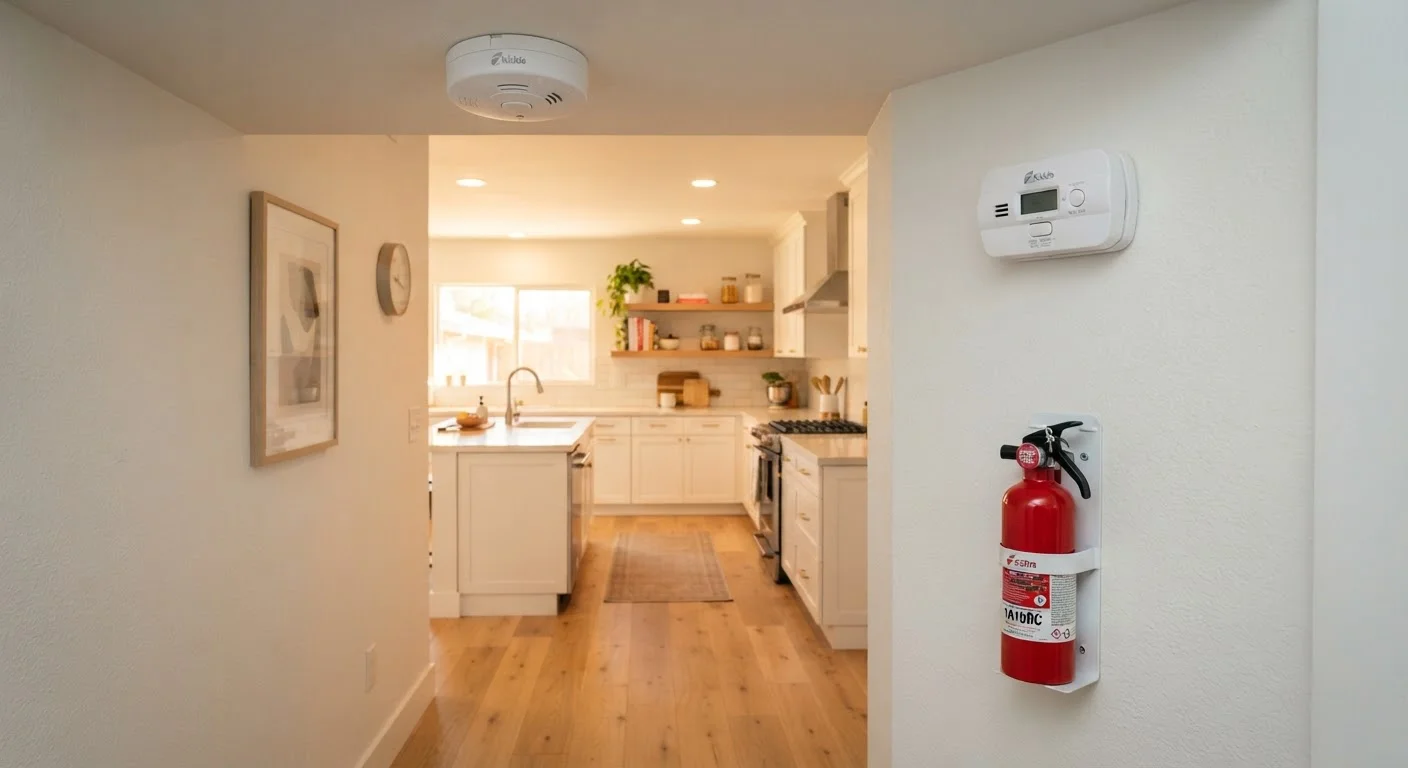
Placement standards: Install detectors on every level of the home, inside each bedroom, and outside each sleeping area. Mount them on the ceiling or high on a wall (typically within 12 inches of the ceiling). Keep them at least 10 feet from cooking appliances to reduce nuisance alarms, and away from bathrooms where steam can trigger false alerts.
Combination Detectors: Convenient, But Know the Tradeoffs
Combination smoke and CO alarm units are available and save wall or ceiling space, but they share a single service life clock. Because CO alarms typically need replacement sooner (5-7 years) than standalone smoke detectors (10 years), a combination unit's lifespan is generally governed by the shorter CO sensor life. Check the manufacturer's rated lifespan before assuming the unit is still reliable.
CO Alarms: The Invisible Threat
Carbon monoxide is colorless and odorless, which makes CO alarms non-negotiable in any home with gas appliances, an attached garage, or a fuel-burning heating system. Many states legally require them - verify your local code requirements.
Testing frequency: Test CO alarms monthly using the test button, just like smoke detectors. If the alarm chirps intermittently (not during a test), it's typically signaling a low battery or end-of-life alert - check the manual for your specific unit's chirp patterns.
Replacement schedule: Most CO alarms have a service life of 5 to 7 years, shorter than smoke detectors, because the electrochemical sensor that detects CO degrades over time. Check the manufacture date on the label and replace accordingly.
Placement: Install CO alarms on every level of the home and near sleeping areas so occupants can hear the alarm while asleep. Unlike smoke, CO disperses relatively evenly, so detectors don't need to be ceiling-mounted - many manufacturers recommend placing them at knee to chest height. Follow the instructions that come with your specific unit. If your home has older systems or hidden risks, our article on hidden maintenance needs in older homes may be worth a read.
Fire Extinguishers: Inspection, Readiness, and Recharging
Monthly visual check: Look at the pressure gauge - the needle should be in the green zone. Check that the pull pin is intact and the nozzle or hose shows no visible damage or blockage. If anything looks off, have the unit professionally inspected or replaced.
Annual professional inspection: A qualified fire equipment service technician should inspect extinguishers once a year. This is distinct from your monthly visual check and may be required by local code in some jurisdictions.
After any use: Even a brief discharge means the extinguisher must be recharged or replaced before it can be relied upon again. A partially discharged unit cannot be assumed safe for future emergencies.
Placement and type: Keep at least one extinguisher in the kitchen - the most common location for household fires. Additional units in the garage and on each floor are sensible in larger homes. For general household use, look for a multipurpose dry-chemical extinguisher rated for Class A (ordinary combustibles), B (flammable liquids), and C (electrical) fires. Mount it in a visible, accessible location - never stored inside a cabinet where it's hard to grab quickly.
Not sure whether to handle safety device installation yourself or call in help? Our guide on DIY maintenance vs. hiring a pro can help you decide.
Ionization smoke detector
A type of smoke alarm that uses a small amount of radioactive material to detect fast-flaming fires. It tends to respond more quickly to open flames than to slow, smoldering fires.
Photoelectric smoke detector
A type of smoke alarm that uses a light beam and sensor to detect smoke particles. It typically responds faster to slow, smoldering fires and produces fewer cooking-related false alarms.
Electrochemical sensor
The sensing technology inside most CO alarms. It uses a chemical reaction to detect carbon monoxide concentrations in the air, and it degrades over time, which is why CO alarms must be replaced on a set schedule.
UL listing
A certification from Underwriters Laboratories indicating a product has been tested and meets specific safety performance standards. Look for this marking on smoke detectors, CO alarms, and fire extinguishers.
Class ABC extinguisher
A multipurpose fire extinguisher rated to handle ordinary combustibles (Class A), flammable liquids (Class B), and electrical fires (Class C). The most practical choice for general home use.