

Key Takeaways
Option A
Whole Grains
The complete, unstripped kernel - fiber, vitamins, and all.
Best for: People looking to maximize nutrient density and support digestive and metabolic health through everyday eating.
Option B
Refined Grains
The processed, lighter grain - convenient but nutritionally trimmed down.
Best for: Situations where texture, shelf stability, or palatability takes priority, though enrichment restores some lost nutrients.
If your goal is maximizing daily fiber and nutrient intake
Whole Grains
Whole grains deliver fiber, magnesium, B vitamins, and antioxidants in a single food - nutrients that refined grains largely shed during processing.
If you need long shelf life or very fine baking texture
Refined Grains
Removing the oil-rich germ extends shelf stability, and refined flour produces the smooth, light texture required for certain baked goods.
If you want a middle-ground approach for a mixed household
Whole Grains
Many whole grain products - whole wheat pasta, brown rice, oats - match the taste and convenience of refined alternatives while delivering significantly more nutrition.
What Happens Inside the Mill
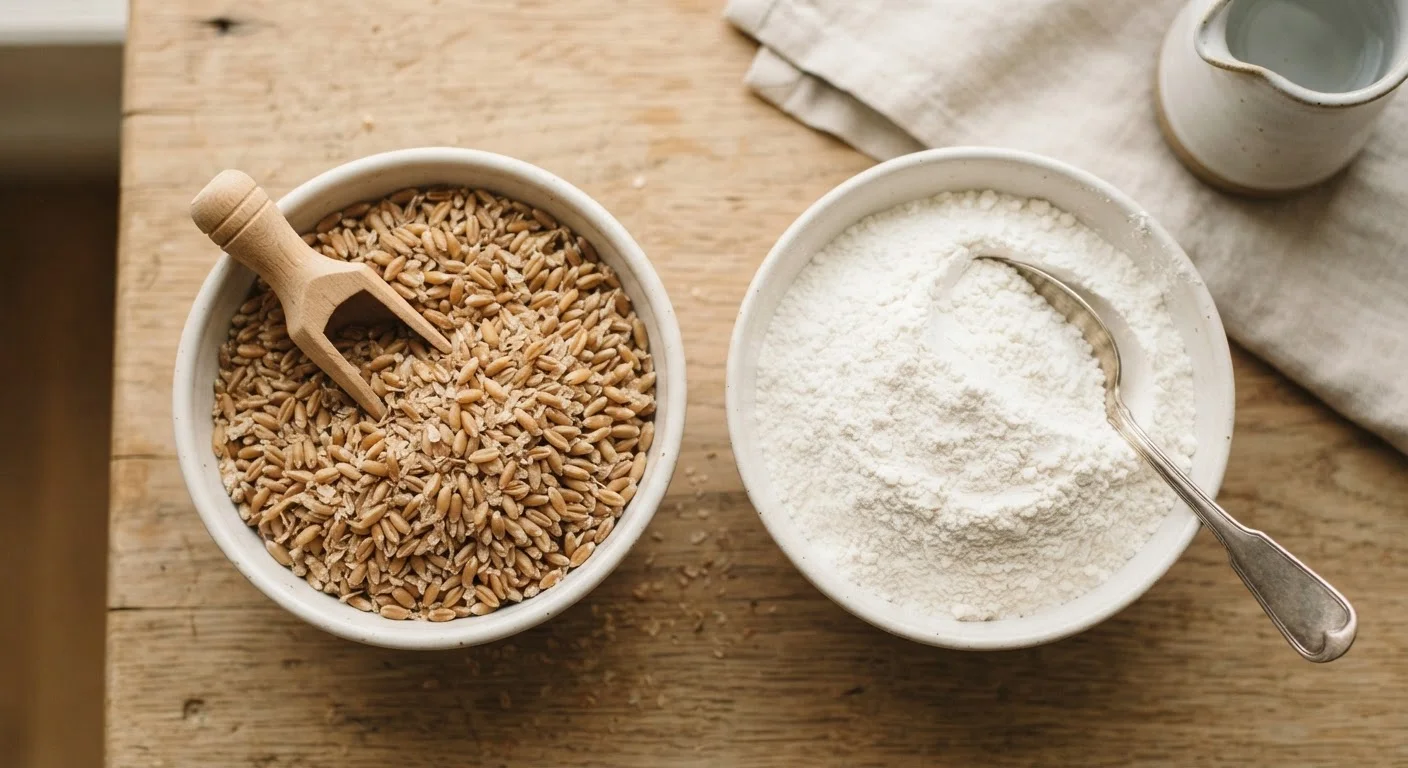
Every grain kernel is made up of three distinct layers: the outer bran, the nutrient-dense inner germ, and the starchy center called the endosperm. A whole grain retains all three. When grain is milled into white flour or white rice, the bran and germ are stripped away, leaving primarily the endosperm.
That processing step is not incidental - it removes the majority of the grain's nutritional value. The bran layer contains most of the fiber and a significant share of B vitamins. The germ holds vitamin E, healthy unsaturated fats, and additional B vitamins. What remains in the endosperm is mostly starch and a smaller concentration of protein.
The reason milling became widespread was practical: removing the fat-containing germ dramatically extends shelf life and produces a finer texture that many consumers prefer. White flour also behaves differently in baking, yielding lighter, more consistent results. These are real trade-offs, not just marketing decisions.
| Criterion | Whole Grains | Refined Grains |
|---|---|---|
| Grain layers retained | Bran, germ, and endosperm | Endosperm only |
| Dietary fiber per serving | Significantly higher | Low (not restored by enrichment) |
| B vitamins | Naturally present | Partially added back via enrichment |
| Vitamin E and healthy fats | Present (from germ) | Largely removed |
| Shelf life | Shorter (oils in germ can go rancid) | Longer |
| Texture in baking | Denser, heartier | Lighter, finer |
| Phytonutrients | Retained | Largely absent |
What Enrichment Does - and Doesn't - Fix
In the United States, many refined grain products are enriched, meaning manufacturers add back specific nutrients - typically thiamine, riboflavin, niacin, folic acid, and iron - after milling. Enrichment was introduced in the 1940s as a public health measure to address widespread nutrient deficiencies, and it has been effective at that goal.
However, enrichment is selective. It restores a handful of nutrients but does not replace the full spectrum of what milling removes. Fiber is the most significant gap. Whole grains naturally contain several grams of dietary fiber per serving; enriched white flour contains very little. Magnesium, zinc, and various phytonutrients (plant compounds with potential health-supporting roles) are also largely absent from refined grains, even enriched ones.
What "Enriched" Actually Means
The U.S. FDA sets standards for which nutrients must be added to enriched grain products sold domestically. These standards target historically common deficiency nutrients - particularly B vitamins and iron. While enrichment has measurably reduced certain nutritional deficiencies at the population level, it was not designed to replicate the complete nutritional profile of an unprocessed grain. Think of it as a partial restoration, not a full replacement.
This is why nutrition researchers and public health guidelines consistently recommend making at least half of your grain servings whole grains - not because refined grains are harmful, but because whole grains provide a broader nutritional return for the same caloric investment. For more on getting key nutrients from food rather than pills, see our guide to whole foods versus supplements.
How to Actually Spot a Whole Grain on a Label
Food packaging can be misleading. Terms like multigrain, wheat bread, or made with whole grain do not guarantee that a product is primarily whole grain. The only reliable method is checking the ingredient list.
Look for the word "whole" before a grain name as the first ingredient: whole wheat flour, whole oats, whole grain corn. If the first ingredient reads simply "wheat flour" or "enriched flour," the product is predominantly refined, regardless of what the front label claims.
Common true whole grains to look for include oats (which are rarely refined), brown rice, whole wheat, bulgur, farro, barley, quinoa, and popcorn. Each retains its full grain structure and delivers the fiber and micronutrients associated with whole grain consumption.
3-5g
Typical fiber per serving in whole grains
Compared to less than 1g per serving in many refined grain products, according to USDA food composition data.
~25%
Share of Americans meeting whole grain intake recommendations
Dietary Guidelines for Americans data consistently show most adults fall short of the recommended whole grain intake.
If you already eat a largely plant-forward diet, incorporating whole grains is a natural complement. Our overview of plant-based eating and its trade-offs covers how grains fit into that broader nutritional picture.
This article is for general informational purposes only and is not a substitute for personalized dietary or medical advice. Consult a registered dietitian or qualified healthcare provider for guidance specific to your health needs.