

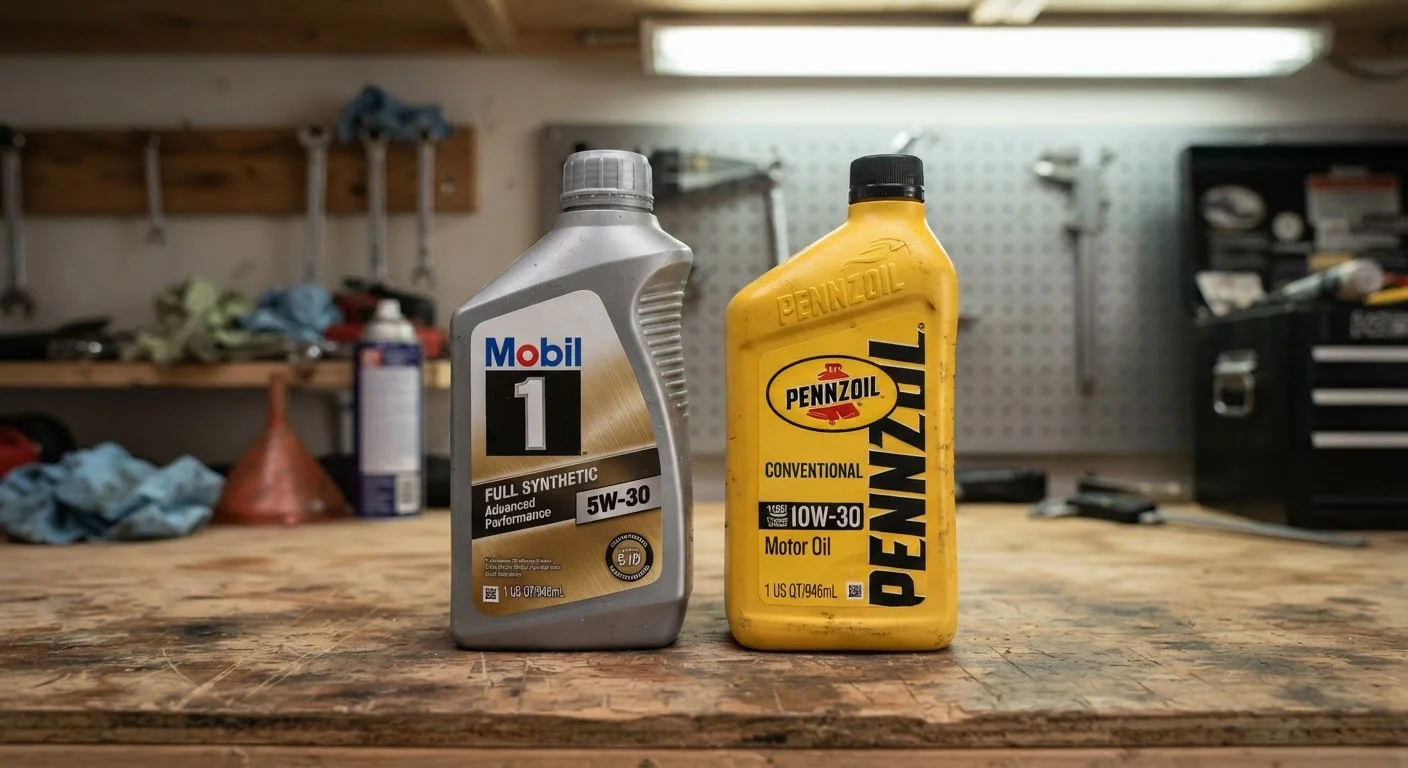
Key Takeaways
Option A
Synthetic Motor Oil
The engineered, high-performance option.
Best for: Drivers with newer vehicles, turbocharged engines, extreme climates, or longer intervals between oil changes.
Option B
Conventional Motor Oil
The time-tested, budget-friendly standard.
Best for: Older vehicles with simple engines and drivers following shorter, more frequent oil change schedules.
If you drive a newer vehicle or one with a turbocharged engine
Synthetic Motor Oil
Modern turbocharged and high-compression engines run hotter and demand tighter lubrication tolerances - synthetic oil's engineered consistency holds up better under those conditions.
If you drive an older, high-mileage vehicle on a tight budget
Conventional Motor Oil
Many older engines were designed around conventional oil, and the lower cost per change can be practical when more frequent intervals are needed anyway.
If you live in a region with extreme hot or cold temperatures
Synthetic Motor Oil
Synthetic oil flows more reliably at cold startup and resists breakdown at high heat, giving it a measurable advantage in temperature extremes.
If your manufacturer explicitly specifies conventional oil
Conventional Motor Oil
Always follow the manufacturer's specification. Using a different oil type than specified - even a 'better' one - can affect warranty coverage and engine behavior.
If you want fewer oil changes and longer service intervals
Synthetic Motor Oil
Synthetic oil is generally rated for significantly longer intervals, which can offset its higher upfront cost over time.
How These Two Oils Are Actually Made
The most important difference between synthetic and conventional motor oil isn't what they do - it's how they're created. Conventional oil is refined from crude petroleum. That refining process removes many impurities, but the resulting molecules are still irregular in size and shape. Those inconsistencies affect how the oil flows and how well it holds up under heat and friction over time.
Synthetic oil, by contrast, is chemically engineered. Chemists build the base oil molecules from scratch - or restructure them from refined petroleum in a more controlled process - so the result is highly uniform. That molecular consistency is what gives synthetic oil most of its performance advantages. It's not magic; it's precision chemistry applied to a very specific job.
There's also a middle category: synthetic-blend oil, which mixes synthetic base stock with conventional oil. It sits between the two in both performance and price, and it's worth knowing about if you see it on a shelf or in your owner's manual recommendations.
What 'Full Synthetic' Actually Means
The term 'full synthetic' isn't uniformly regulated across all markets, which means labeling can vary between manufacturers. In practice, look for the API (American Petroleum Institute) certification mark on the label, and cross-reference your owner's manual viscosity grade rather than relying solely on marketing language. The viscosity grade - such as 5W-30 - is the specification your engine was engineered around.
Performance, Protection, and Change Intervals
Synthetic oil's uniform molecular structure gives it two well-documented practical advantages. First, it flows more readily at cold temperatures, which matters most at startup - the period when most engine wear actually occurs. Second, it resists thermal breakdown better at high temperatures, which is especially important for turbocharged engines and stop-and-go city driving where heat builds quickly.
Change intervals differ significantly. Many synthetic oils are rated for 7,500 to 10,000 miles or more between changes, depending on the vehicle and driving conditions. Conventional oil is typically rated for 3,000 to 5,000 miles. However, these are general ranges - your owner's manual specifies the correct interval for your engine. Following the manual matters more than following any generic rule. See our guide to common oil change myths for why the old 3,000-mile standard is outdated for most modern vehicles.
| Criterion | Synthetic Oil | Conventional Oil |
|---|---|---|
| Base composition | Engineered/chemically structured | Crude petroleum refined |
| Cold-start flow | Flows quickly in cold temps | Slower flow in cold weather |
| Heat resistance | High thermal stability | Breaks down faster under heat |
| Typical change interval | 7,500-10,000+ miles (varies) | 3,000-5,000 miles (varies) |
| Cost per quart | Higher upfront cost | Lower upfront cost |
| Turbocharged engines | Generally recommended | Often insufficient |
| Older/simpler engines | Compatible, check manual | Often appropriate |
Cost: Upfront Price vs. Total Cost Over Time
Conventional oil costs less per quart - often noticeably so. For drivers who change their own oil, that price difference is easy to feel immediately. But the comparison gets more nuanced when you factor in change intervals. If synthetic oil genuinely lasts twice as long between changes, the per-mile cost can be comparable or even lower over time, even with the higher purchase price.
2x
Longer typical change interval for synthetic vs. conventional
Synthetic oils are commonly rated for roughly double the mileage of conventional oil, though actual intervals depend on the vehicle manufacturer's specification.
75,000+
Miles commonly considered 'high mileage' threshold
Vehicles past this mileage mark may benefit from oils formulated with seal conditioners - a factor worth discussing with a mechanic before changing oil type.
That said, the math depends on your actual driving habits. A driver who puts on very low mileage each year may not reach the synthetic oil's extended interval before a time-based change is recommended anyway. For those drivers, the cost equation shifts back toward conventional. Understanding your own situation - mileage, driving conditions, vehicle age - is more useful than any blanket cost claim.
If you're unsure how to read your oil specs or find the recommended change interval, your owner's manual contains that information and it's more reliable than advice from any third party.
Which Oil Does Your Engine Actually Need?
The single most reliable answer to this question lives in your vehicle's owner's manual. Manufacturers specify oil viscosity grades (like 5W-30 or 0W-20) and, increasingly, specify synthetic oil outright for newer models. If your manufacturer requires synthetic, using conventional oil isn't a cost-saving move - it's a spec violation that could affect your warranty and engine longevity.
High-mileage vehicles - generally those with more than 75,000 miles - are sometimes a separate consideration. Some oils are formulated specifically for engines with more wear, containing seal conditioners that help reduce minor leaks. If your vehicle is in that range and you're noticing oil consumption or seepage, that's worth discussing with a qualified mechanic before switching oil types or brands. See our overview of what's under your hood for help identifying what you're looking at when you check your dipstick.
For most drivers with modern vehicles, synthetic oil is the practical default - not because it's a premium upgrade, but because most current engines are engineered around its properties. For older, simpler engines running well on conventional oil with no issues, switching isn't necessarily required. When in doubt, a qualified mechanic can advise based on your specific engine's condition and history.