

Key Takeaways
Auto Insurance Coverage Types
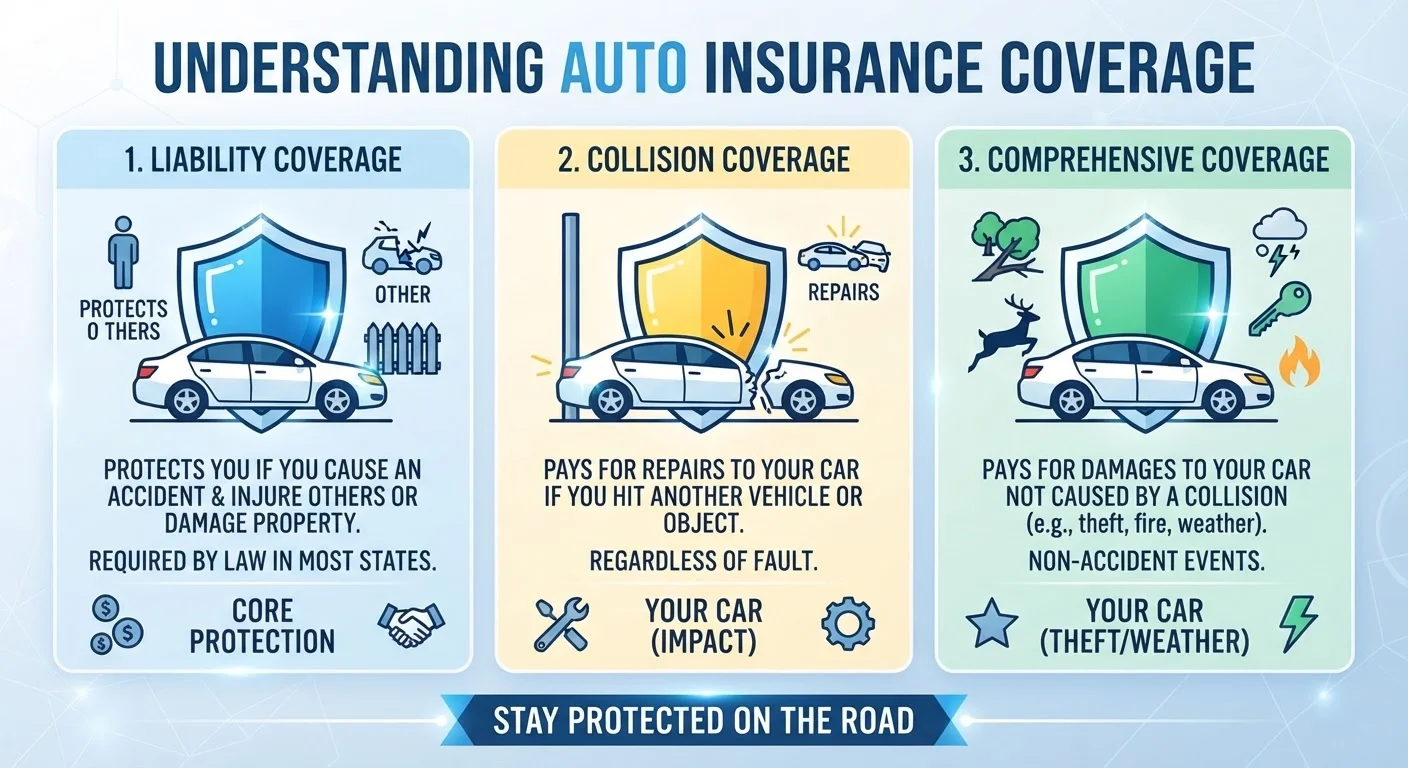
Auto insurance is divided into distinct coverage types, each designed to pay for specific kinds of losses. Liability covers damage you cause to others. Collision covers damage to your own vehicle from a crash. Comprehensive covers damage to your vehicle from non-collision events like theft, weather, or animals. Together, these three form the core building blocks of most auto policies.
Liability coverage is typically expressed as a split limit (e.g., 25/50/25) or a single combined limit; collision and comprehensive are subject to a deductible you choose at purchase.
Liability Coverage: What You Owe Others After an Accident
Liability coverage is the foundation of virtually every auto insurance policy and is required by law in nearly every U.S. state. It pays for the damages you cause to other people - not to yourself or your own vehicle.
There are two components to liability coverage:
- Bodily injury liability: Pays for medical expenses, lost wages, and legal costs if you injure someone else in a crash you caused.
- Property damage liability: Covers repair or replacement costs for another person's vehicle or property - a fence, a parked car, a storefront - damaged in an accident you caused.
Liability limits are often written as three numbers, such as 100/300/100. This means $100,000 per person for bodily injury, $300,000 per accident for bodily injury, and $100,000 for property damage. If damages exceed your limits, you're personally responsible for the remainder.
State minimums are a legal floor, not a recommendation. Many financial advisors suggest carrying limits well above state minimums if your assets are worth protecting. For a broader look at how policy structures work, see our auto insurance overview.
Liability Covers Others, Not You
A common misconception is that liability insurance protects the policyholder. It does not - it protects the other party when you're at fault. To cover your own injuries or vehicle damage, you need additional coverage types such as collision, comprehensive, personal injury protection (PIP), or medical payments coverage.
Collision Coverage: Repairing Your Vehicle After a Crash
Collision coverage pays to repair or replace your vehicle when it's damaged in a crash - whether you hit another car, a guardrail, or a telephone pole. Critically, it applies regardless of who caused the accident.
Here's what that means in practice: if you're found at fault, your liability coverage pays the other driver's damages, while your collision coverage handles your own vehicle. If another driver is at fault, you can file against their liability policy - but if that process is delayed or disputed, your collision coverage lets you move forward with repairs immediately.
Collision coverage is subject to a deductible, typically ranging from $250 to $2,000. You choose this amount when you buy your policy. A higher deductible lowers your monthly premium but means more out-of-pocket expense when you file a claim.
Lenders and leasing companies almost universally require collision coverage when a vehicle is financed. Once a car is paid off, the choice becomes yours. For a detailed comparison, our article on collision vs. comprehensive walks through when each applies.
Match Your Deductible to Your Savings
When choosing a deductible for collision or comprehensive, think about how much you could comfortably pay out of pocket in an emergency. If a $1,000 deductible would strain your budget after a fender-bender, a lower deductible - even at a higher premium - may be the more practical choice for your situation.
Comprehensive Coverage: Protection Beyond the Road
Comprehensive coverage - sometimes called "other than collision" - pays for damage to your vehicle caused by events outside of a typical traffic accident. This is the coverage that steps in when nature, theft, or random misfortune damages your car.
Common scenarios covered under comprehensive include:
- Theft or attempted theft
- Vandalism
- Hail, wind, flood, or other weather events
- Fire
- Falling objects (trees, debris)
- Animal collisions (such as hitting a deer)
Like collision, comprehensive is subject to a deductible. It does not cover mechanical breakdowns or normal wear and tear - those fall outside the scope of any standard auto insurance policy.
Deciding whether to carry comprehensive depends largely on your vehicle's current market value. If the car's actual cash value is low, the payout in a total loss may not justify the added premium cost. For context on how these decisions fit into broader coverage choices, see our guide on full coverage vs. minimum coverage.
~13%
Uninsured drivers on U.S. roads
According to the Insurance Research Council, roughly 1 in 8 drivers in the U.S. is uninsured, underscoring why your own coverage choices matter.
$500-$2,000
Typical collision/comprehensive deductible range
Most auto policies offer deductible options in this range; the amount you choose directly affects both your premium and your out-of-pocket cost at claim time.
Most states
Require liability coverage by law
Nearly all U.S. states mandate a minimum level of liability insurance; only a small number allow alternatives such as proof of financial responsibility.
How These Three Work Together in a Real Claim
In practice, the three coverage types often interact within a single incident. Understanding which one applies - and when - removes a lot of the confusion that drivers face at claim time.
Consider a driver who runs a red light and hits another vehicle. Their liability coverage pays for the other driver's car repairs and medical bills. Their own collision coverage pays for their own vehicle damage. If a storm then drops a tree on the repaired car while it sits in a driveway, comprehensive coverage handles that loss.
No single coverage type is a catch-all. Gaps appear when drivers carry only the minimum liability required by law and face a situation where their own vehicle or medical costs aren't covered. That's why understanding what each pays for - before you need it - matters.
For plain-language definitions of common insurance terms like deductibles, actual cash value, and subrogation, the auto insurance glossary is a useful reference. And if you're concerned about scenarios involving uninsured drivers, uninsured motorist coverage fills an important gap that liability, collision, and comprehensive don't address.
This article is for general informational purposes only and does not constitute personalized insurance or financial advice. Coverage terms, exclusions, and availability vary by provider and state. Read your policy documents carefully and consult a licensed insurance professional for guidance specific to your situation.