

Key Takeaways
The Greek Islands
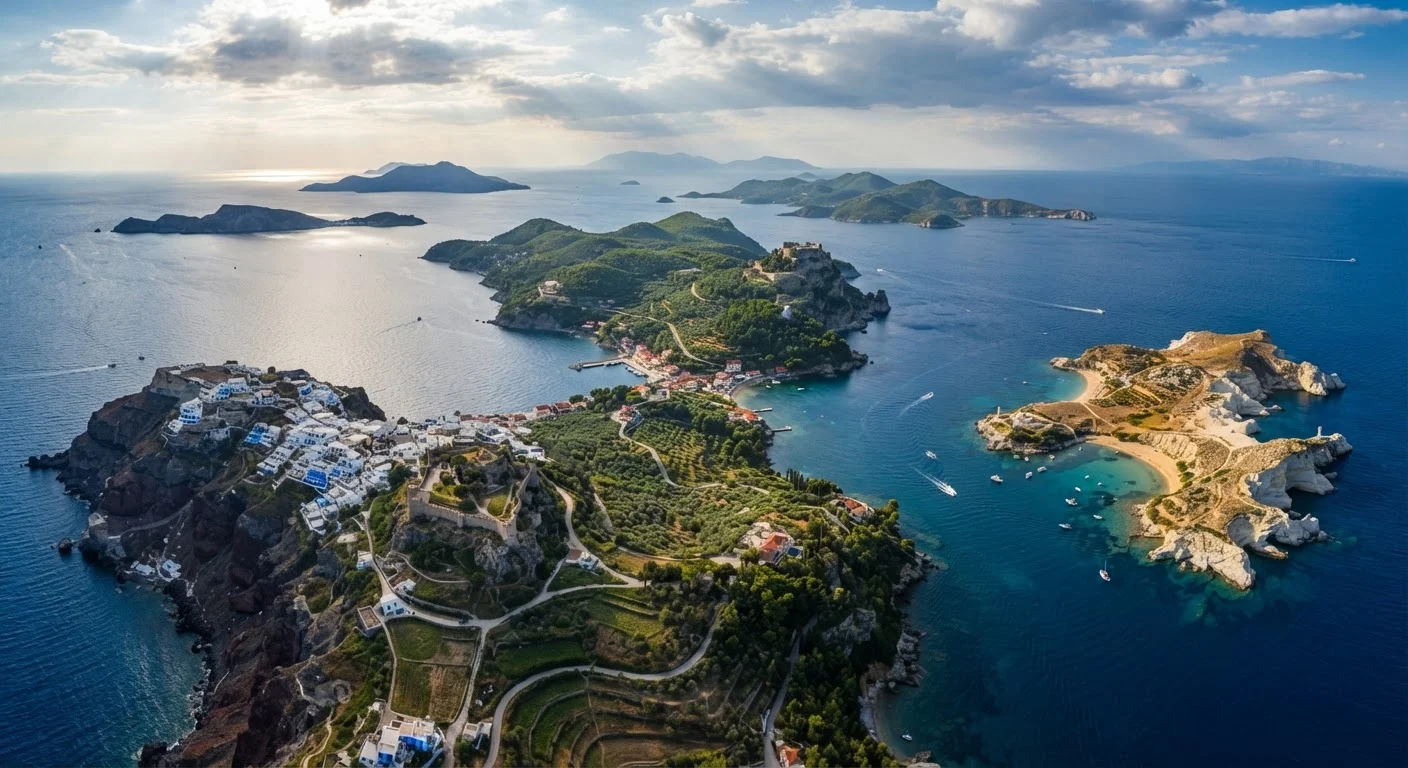
"The Greek Islands" is a collective term for more than 6,000 islands and islets scattered across the Aegean, Ionian, and Mediterranean seas - fewer than 230 of which are inhabited. These islands are grouped into distinct archipelagos, each with its own landscape, history, climate, and character. Treating them as one homogenous destination leads to mismatched expectations and poorly planned trips.
The major island groups include the Cyclades, Dodecanese, Ionian Islands, Northeastern Aegean Islands, Sporades, and Crete, which stands alone as Greece's largest island.
Why This Distinction Matters Before You Book
A traveler who books a Greek island trip expecting the blue-domed churches of Santorini but lands on the forested hills of Corfu will find something genuinely beautiful - just not what they pictured. The reverse is equally true. Greece's islands span different seas, climates, architectural styles, and cultural histories, and conflating them creates a mismatch between expectation and experience.
Each island group developed under different rulers - Byzantine, Venetian, Ottoman, Italian - and that history is visible in the buildings, food, and local customs today. Understanding which island fits your priorities is the most useful planning step you can take.
6,000+
Total Greek islands and islets
According to Greek government sources, fewer than 230 of these are permanently inhabited.
~160 miles
East-to-west length of Crete
Crete's scale means its western and eastern regions have distinctly different landscapes and visitor experiences.
6
Major island groups in Greece
The Cyclades, Dodecanese, Ionian Islands, Northeastern Aegean, Sporades, and Crete each have distinct histories and geographies.
Santorini: Volcanic Drama and Its Trade-offs
Santorini is the island most people picture when they think of Greece: white cubic buildings cascading down a caldera rim, blue-domed churches, and sunset views over a flooded volcanic crater. That image is accurate. So is the crowd that comes with it.
The island's terrain is almost entirely volcanic - black sand and red lava beaches replace the pale golden shores found elsewhere. It's compact, relatively easy to navigate, and has a well-developed infrastructure for short stays. But its popularity means accommodation costs are among the highest in the country, footpaths along the caldera can feel congested in high season, and cruise ships deposit thousands of day visitors into Fira and Oia daily from June through September.
Santorini rewards travelers who want a visually intense, relatively short trip and are prepared for the price and pace that comes with it.
Corfu, Rhodes, and Crete: Three Very Different Profiles
Corfu sits in the Ionian Sea off Greece's northwestern coast - geographically and culturally distinct from the Aegean islands. Venetian rule for four centuries left behind a walled old town, cricket on the esplanade, and a cuisine that leans toward sofrito and pastitsada rather than standard taverna fare. The island is visibly greener than most Aegean destinations, with olive groves, cypress trees, and a hillier interior. It suits travelers who want history, culture, and lush scenery alongside the beach.
Rhodes, the largest of the Dodecanese, anchors its appeal in a UNESCO-listed medieval city - one of the best-preserved in Europe - while also offering long stretches of sandy beach along its eastern coast. The island has reliable sunshine, good transport links, and enough variety to satisfy both history enthusiasts and those who simply want sun and water. Its Italian colonial period (early 20th century) left a distinct architectural imprint in the new town that sets it apart from typical Cycladic aesthetics.
Crete is the outlier in any comparison because of its sheer size. At roughly 3,200 square miles, it contains mountain ranges, gorges (including the famous Samaria Gorge), Minoan archaeological sites, beach resorts, and quiet inland villages that feel untouched by tourism. The western end around Chania is generally considered more scenic and less developed than the resort-heavy areas near Heraklion. Travelers who give Crete only two or three days miss most of what makes it worth visiting.
How to Match the Island to Your Travel Style
The clearest way to choose is to start with your daily priorities rather than a name.
- Iconic scenery and short stay: Santorini or Mykonos in the Cyclades.
- History layered with beach time: Rhodes or Crete's Chania region.
- Green landscape and Venetian culture: Corfu or Kefalonia in the Ionian Islands.
- Fewer crowds, more local character: Naxos, Samos, Ikaria, or Milos - all significantly quieter than the headline names.
Just as travelers who want Iceland beyond the postcards should look past the Golden Circle - see our guide to Iceland's lesser-visited regions for a parallel example - those who want Greece beyond the brochure should consider islands that rarely headline travel magazines.
Plan Around the Ferry Schedule, Not Just the Map
A pair of islands that look close on a map may require a long indirect ferry route or a return to Athens between them. Before finalizing your itinerary, check actual ferry connections for your travel dates using official ferry operator schedules or the Greek ports authority. Building flexibility into your schedule - especially in shoulder season when frequency drops - prevents the most common island-hopping frustration.
Ferry connections vary significantly depending on which islands you combine, so check routes before finalizing an itinerary. Not every pair of islands has a direct link, and routing through Athens (Piraeus port) may be necessary.