

Key Takeaways
Start here
The Right Mindset Before You Begin
Next
Core Concepts Every New Trainer Needs to Know
Then try
Your First Week: What to Actually Teach
Watch out for
Common Beginner Mistakes and How to Avoid Them
Long game
Building Habits That Last
The Right Mindset Before You Begin
Dog training isn't about dominance or control - it's about communication. Your dog genuinely wants to understand what you expect; they just don't speak your language yet. The fastest path to a well-behaved dog is teaching that language clearly, calmly, and consistently from the very first day.
Think of yourself as a guide rather than a disciplinarian. Every meal, every walk, every greeting at the door is a micro-training moment. Dogs learn from patterns, and the patterns you establish in week one will echo for years. Before you ever ask for a formal "sit," your dog is already picking up cues about how your household works.
To set the stage well, pair your training mindset with solid daily care. Our new pet owner's daily care guide covers the feeding schedules, exercise, and vet-visit basics that underpin a settled, trainable dog.
Start as you mean to go on
Decide your household rules before your dog arrives - which furniture is off-limits, where sleeping spots are, how guests should greet the dog - and apply them from day one. It's far easier to maintain a boundary that was never crossed than to walk back a habit your dog has already formed.
Core Concepts Every New Trainer Needs to Know
You don't need a professional background to train your dog effectively. You do need a working grasp of a few key principles that shape how dogs actually learn.
Positive reinforcement
A training method where you reward your dog immediately after they perform a desired behavior, making that behavior more likely to happen again.
Marker
A precise signal - often a word like "yes" or the click of a clicker - used to pinpoint the exact moment your dog does something right, right before the reward arrives.
Luring
Using a treat or object to physically guide your dog into a position or behavior, then gradually fading the lure once the dog understands the cue.
Proofing
Practicing a learned behavior in many different environments and situations so your dog can perform it reliably even when distractions are present.
Impulse control
Your dog's ability to pause and wait rather than act on every impulse - a skill that underlies many polite behaviors like not jumping on guests or dashing through open doors.
Socialization
The process of gradually and positively exposing your dog to a wide variety of people, animals, sounds, and environments so they grow comfortable in the world around them.
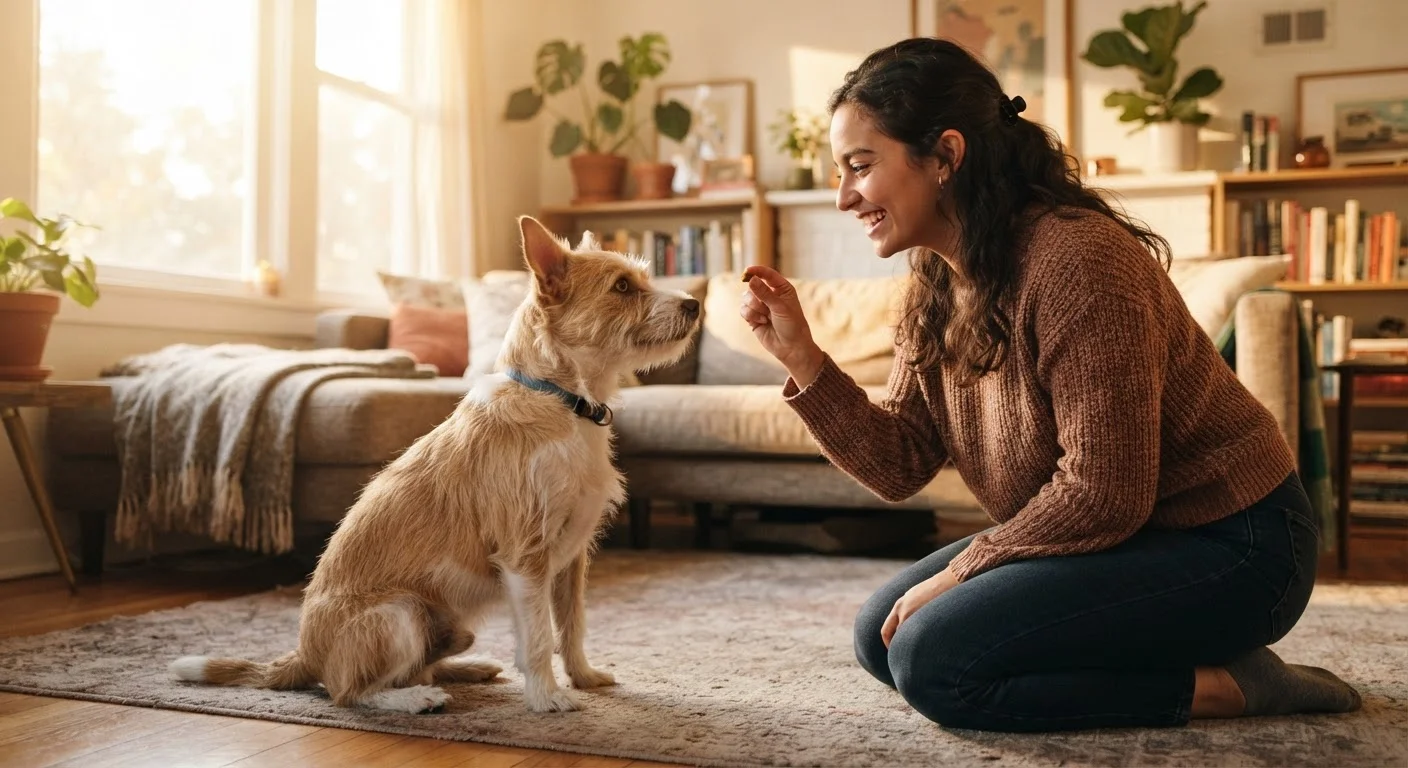
The practical takeaway: mark the exact moment your dog does what you want - with a word like "yes" or a clicker - then immediately deliver a reward. Timing matters more than most new owners realize. A reward that arrives three seconds late may reinforce whatever your dog did in those three seconds, not the behavior you intended.
It's also worth noting that training and socialization are related but not the same thing. Training teaches your dog how to respond to cues. Socialization builds their comfort with the world around them - new people, sounds, environments, and other animals. Both are essential. Our article on socialization vs. training explains how the two work together.
Your First Week: What to Actually Teach
Keep the first week focused and simple. Trying to cover too much too soon leads to confusion for your dog and frustration for you. Start with these four foundational cues:
- Sit - the gateway behavior. Easy to teach, immediately useful, and a natural starting point for impulse control.
- Stay - builds self-regulation and is critical for safety in real-world situations.
- Come - the most important cue for your dog's safety. Practice in low-distraction environments first.
- Leave it - prevents your dog from picking up dangerous objects and starts shaping impulse control early.
Work in short sessions - 3 to 5 minutes is plenty. End each session on a success, even if you have to make the last rep easier to ensure it. Before every session, check that your dog isn't tired, hungry, or over-stimulated. Our pre-session quick-check routine walks you through exactly what to verify before you start.
Common Beginner Mistakes and How to Avoid Them
Even well-intentioned owners run into predictable stumbling blocks. Knowing them in advance puts you a step ahead.
Avoid punishment-based methods
Techniques that rely on physical corrections, intimidation, or fear may suppress behavior in the short term but can damage your dog's trust and increase anxiety over time. Many veterinary and behavioral organizations advise against aversive methods, particularly for new trainers who may apply them inconsistently. When in doubt, redirect and reward rather than correct.
- Inconsistency across household members. If one person lets the dog jump up while another corrects it, the dog learns the behavior is sometimes okay - which makes it much harder to extinguish. Align everyone in the home on the same rules before bringing your dog home if possible.
- Sessions that run too long. A bored or tired dog stops learning and may start acting out. Three focused minutes beats twenty wandering ones.
- Repeating cues without compliance. Saying "sit, sit, SIT" teaches your dog that the first cue is optional. Say it once, guide or wait for the behavior, then reward.
- Punishing after the fact. Dogs don't reliably connect a correction to something that happened more than a second or two ago. Addressing a mess you found five minutes later doesn't teach your dog what went wrong - it just creates confusion and anxiety.
Building Habits That Last
The goal isn't a dog who behaves perfectly in a training session - it's a dog who behaves reliably in real life. That takes practice across different settings, gradual increases in distraction, and a consistent daily rhythm.
As your dog masters each foundational cue at home, begin practicing in slightly more challenging environments: the backyard, then a quiet park, then busier spaces. This process, called "proofing," generalizes the behavior so your dog can perform it even when interesting distractions are present.
For ongoing support, consider exploring your training format options - group classes, private sessions, and self-guided programs each offer different advantages depending on your schedule, budget, and learning style. And don't overlook the bigger picture of your dog's overall care: our Pet Care Basics hub covers nutrition, grooming, and health routines that support a happy, trainable dog for the long run.
Training is not a phase you complete - it's an ongoing conversation with your dog. The habits you build now become the foundation for everything that follows.
This article provides general educational information about dog training. It is not a substitute for personalized guidance from a certified professional dog trainer or veterinary behaviorist, particularly if your dog displays aggression, fear, or other behavioral concerns that may require expert assessment.