

Key Takeaways
Built-in schedule creates reliable accountability
A fixed class time acts as an external commitment, making it easier to show up consistently compared to open-ended solo sessions with no set start time.
Social energy often increases effort and enjoyment
Exercising alongside others has been shown to increase workout duration and perceived enjoyment, both of which support long-term adherence.
Instructor guidance reduces injury risk for beginners
Qualified instructors provide real-time cueing on form and technique, which is especially valuable for adults new to structured movement.
Variety is built into the programming
Most group class formats rotate exercises and formats regularly, reducing workout monotony without requiring the participant to plan anything.
Lower barrier to getting started
You don't need to know how to build a program - just show up, follow the instructor, and complete the session alongside others.
Limited personalization for individual goals
A class is designed for a general population, not your specific fitness level, injury history, or performance targets. Modifications may not always be adequate.
Fixed schedule may not suit every lifestyle
Classes run at set times, which can conflict with irregular work hours, family commitments, or travel - reducing access when life gets complicated.
Pace is set by the instructor, not your readiness
You may find the class too fast, too slow, or poorly matched to your recovery state on a given day, with limited ability to adjust in real time.
Crowded environments can limit equipment access
Popular classes sometimes involve waiting for equipment or reduced spacing, which can affect workout quality and comfort.
Our Verdict
Group fitness classes and solo training each deliver real results - but they serve different needs. Classes work best as a consistency tool and community-builder, while solo training shines for anyone with specific performance goals or scheduling constraints. The most effective approach for many adults is a thoughtful blend of both.
Group classes are ideal for adults who thrive on social energy and external structure; solo training suits those who prefer flexibility, autonomy, or have highly specific training goals.
Why This Choice Matters for Long-Term Fitness
Roughly half of Americans who start a new exercise program abandon it within six months, according to research published in the American Journal of Health Behavior. Format - group versus solo - plays a meaningful role in whether people stick with exercise at all. Understanding the trade-offs between these two approaches helps you make a choice grounded in how you actually live, not just how you plan to live.
This isn't about which workout style burns more calories or builds more muscle in a lab. It's about which approach is most likely to keep you moving consistently over weeks, months, and years. For a deeper look at what different exercise types do physiologically, see our guide to strength training vs. cardio.
The Case for Group Fitness Classes
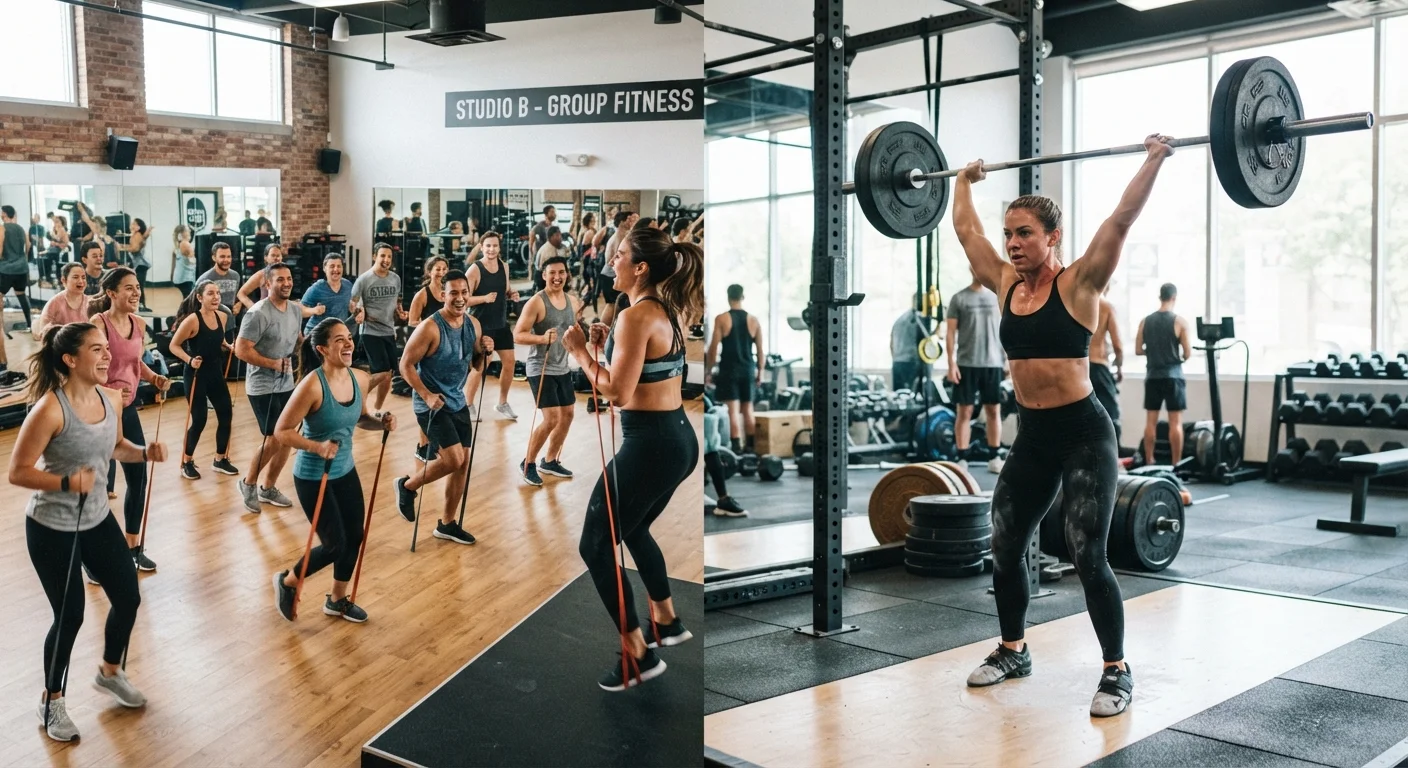
Group fitness formats - from spin and yoga to HIIT and dance cardio - have grown substantially because they solve a problem most people face: motivation. When a class starts at a set time with an instructor and a room full of participants, the barrier to skipping is higher than when your only obligation is a personal intention.
Built-in schedule creates reliable accountability
A fixed class time acts as an external commitment, making it easier to show up consistently compared to open-ended solo sessions with no set start time.
Social energy often increases effort and enjoyment
Exercising alongside others has been shown to increase workout duration and perceived enjoyment, both of which support long-term adherence.
Instructor guidance reduces injury risk for beginners
Qualified instructors provide real-time cueing on form and technique, which is especially valuable for adults new to structured movement.
Variety is built into the programming
Most group class formats rotate exercises and formats regularly, reducing workout monotony without requiring the participant to plan anything.
Lower barrier to getting started
You don't need to know how to build a program - just show up, follow the instructor, and complete the session alongside others.
~50%
Exercise dropout rate within 6 months
Research in the American Journal of Health Behavior suggests roughly half of people who begin a new exercise routine stop within six months, highlighting the importance of sustainable format choices.
200%
Longer exercise duration with a partner
A study published in the Journal of Social Sciences found that exercising with a partner of perceived higher ability led participants to exercise up to twice as long as they did alone.
Social facilitation - performing better in the presence of others - is a well-documented psychological phenomenon. Studies consistently show that exercising alongside others tends to increase effort and duration compared with exercising alone. Instructors also provide real-time form cues, which reduces injury risk for beginners who haven't yet learned movement fundamentals.
Cost can be a consideration, though gym memberships with class access vary widely. If you're also thinking about where to exercise, our comparison of home workouts vs. gym workouts covers the broader trade-offs.
The Case for Solo Training
Training independently offers a degree of personalization and flexibility that group classes structurally cannot match. You choose the exercises, the load, the rest intervals, and the schedule - including the 6 a.m. slot that no studio near you offers, or the lunch-break session that runs exactly 35 minutes.
Limited personalization for individual goals
A class is designed for a general population, not your specific fitness level, injury history, or performance targets. Modifications may not always be adequate.
Fixed schedule may not suit every lifestyle
Classes run at set times, which can conflict with irregular work hours, family commitments, or travel - reducing access when life gets complicated.
Pace is set by the instructor, not your readiness
You may find the class too fast, too slow, or poorly matched to your recovery state on a given day, with limited ability to adjust in real time.
Crowded environments can limit equipment access
Popular classes sometimes involve waiting for equipment or reduced spacing, which can affect workout quality and comfort.
For individuals pursuing specific performance goals - building strength on a progressive overload plan, training for a race, or rehabilitating after injury - solo programming aligned with those goals is difficult to replicate in a general group setting. Self-directed training also builds genuine exercise literacy: over time, you learn how your body responds, how to adjust when fatigued, and how to progress methodically.
The main challenge is accountability. Without external structure, motivation must come from within, which can be harder to sustain, particularly during stressful or busy periods.
How to Decide - or Combine Both
No Single Format Fits Everyone
Fitness research consistently shows that the best workout is the one a person will actually do. Personality traits like introversion or extroversion, responsiveness to social pressure, and preference for autonomy all influence which format feels sustainable. There is no universal right answer - the goal is finding an approach that aligns with how you're genuinely wired, not how you think you should be.
Rather than treating this as a binary choice, consider how your goals, personality, and schedule interact. Ask yourself: Do you find energy in a room full of people, or does a crowd distract you? Do you have a specific goal that requires tailored programming, or are you focused on general health and consistency? Is cost a meaningful constraint?
Many adults find that a hybrid model works well in practice - using group classes for cardiovascular conditioning and community on some days, while training independently on others for strength or skill work. This keeps variety high and reduces the chance of boredom, which is one of the more common reasons people disengage from fitness routines entirely.
This article is for general informational and educational purposes only and is not a substitute for professional medical or fitness advice. Consult a qualified healthcare provider or certified fitness professional before starting or significantly changing an exercise program, particularly if you have an existing health condition or injury.