

| FDA-required label line | "Added Sugars" listed separately under Total Sugars since 2020 (U.S. Food & Drug Administration) |
| Estimated number of names for added sugar | 60+ (University of California, San Francisco SugarScience project) |
| Daily added sugar limit (dietary guidelines) | Less than 10% of daily calories (~50g on a 2,000-calorie diet) (Dietary Guidelines for Americans, 2020-2025) |
| Ingredient list ordering rule | Ingredients listed by weight, heaviest first (FDA labeling regulations) |
| Common disguise tactic | Multiple sugar types used to keep each lower on the ingredient list (General nutrition literacy guidance) |
Why Added Sugar Is So Easy to Miss
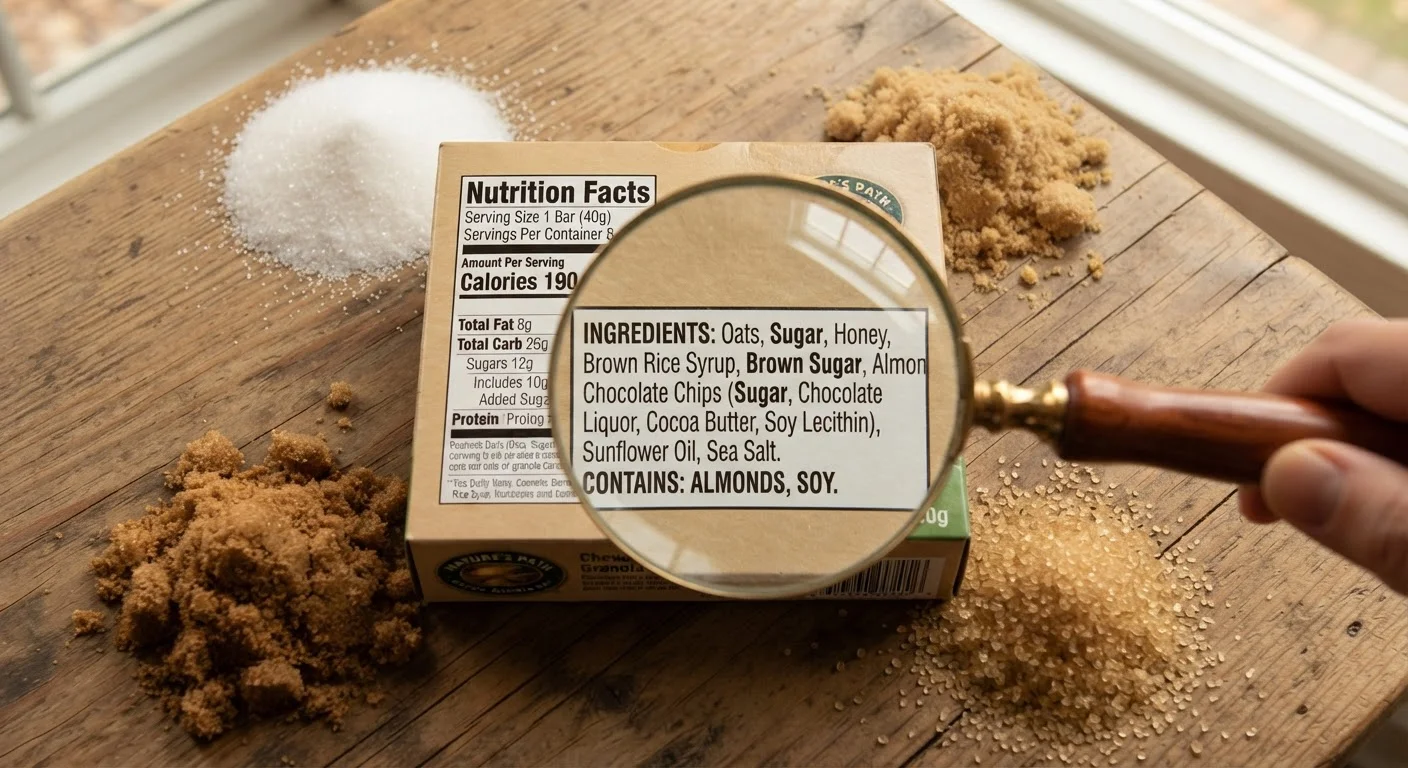
The FDA now requires a separate "Added Sugars" line on Nutrition Facts panels, which helps. But that number only tells you how much is present - it doesn't tell you where it's coming from within the product. For that, you have to read the ingredient list. And ingredient lists are where added sugar truly hides, appearing under more than 60 different names recognized by the FDA and nutrition researchers.
Manufacturers are not being deceptive by using these names - each refers to a real, chemically distinct ingredient. But the practical effect for shoppers is the same: a single food can contain five or six different sugar-based ingredients, none of which says "sugar" outright, yet together they make sugar the dominant ingredient by weight.
Understanding the naming landscape is the fastest way to cut through the confusion. For a related skill in decoding what labels say - and don't say - see how to read a supplement label.
| FDA-required label line | "Added Sugars" listed separately under Total Sugars since 2020 (U.S. Food & Drug Administration) |
| Estimated number of names for added sugar | 60+ (University of California, San Francisco SugarScience project) |
| Daily added sugar limit (dietary guidelines) | Less than 10% of daily calories (~50g on a 2,000-calorie diet) (Dietary Guidelines for Americans, 2020-2025) |
| Ingredient list ordering rule | Ingredients listed by weight, heaviest first (FDA labeling regulations) |
| Common disguise tactic | Multiple sugar types used to keep each lower on the ingredient list (General nutrition literacy guidance) |
The Many Names for Added Sugar
Added sugars fall into a few recognizable categories. Grouping them makes the list far less overwhelming.
Syrups
- High-fructose corn syrup (HFCS)
- Corn syrup and corn syrup solids
- Brown rice syrup
- Malt syrup
- Maple syrup
- Agave nectar or syrup
- Molasses and blackstrap molasses
- Glucose syrup
Words Ending in "-ose"
- Sucrose (table sugar)
- Fructose
- Glucose
- Dextrose
- Maltose
- Lactose (when added beyond what naturally occurs in a product)
- Galactose
"Sugar" in the Name
- Cane sugar, raw cane sugar, turbinado sugar
- Coconut sugar
- Beet sugar
- Brown sugar, powdered sugar, confectioners' sugar
- Date sugar
- Invert sugar
Less Obvious Forms
- Honey
- Fruit juice concentrate
- Evaporated cane juice
- Caramel
- Dextrin and maltodextrin
- Barley malt
- Carob syrup
Added sugars
Sugars and syrups added to foods during processing or preparation, as distinct from sugars that occur naturally in whole foods like fruit or plain dairy.
High-fructose corn syrup (HFCS)
A liquid sweetener made from corn starch in which some glucose has been converted to fructose. It is widely used in processed foods and beverages.
Invert sugar
A mixture of glucose and fructose made by breaking down sucrose. It stays liquid longer than table sugar, making it useful in baked goods and candies.
Evaporated cane juice
A minimally processed sweetener derived from sugar cane. Despite its name, the FDA considers it a form of sugar and requires it to be declared as such on labels.
Fruit juice concentrate
Juice that has had most of its water removed, concentrating its natural sugars. When added to other products, it counts as an added sugar.
Dextrose
Another name for glucose derived from corn or wheat starch. It is chemically identical to blood glucose and is used as a sweetener and preservative.
When you see several of these in a single ingredient list - especially near the top - the product is likely high in added sugar even if no single entry looks alarming on its own.
What the Daily Limits Mean in Practice
The Dietary Guidelines for Americans recommend limiting added sugars to less than 10% of total daily calories. On a 2,000-calorie diet, that works out to about 50 grams, or roughly 12 teaspoons, per day. The American Heart Association recommends lower limits for many adults - around 25 grams for women and 36 grams for men - though these are general guidance figures, not prescriptions for any individual.
~17 tsp
Average daily added sugar intake for U.S. adults
According to CDC data, Americans consume well above the recommended 12-teaspoon daily ceiling on average.
39g
Added sugar in a typical 12-oz soda
A single regular soft drink can approach or exceed the American Heart Association's suggested daily limit for many adults.
10%
Maximum recommended share of daily calories from added sugar
Dietary Guidelines for Americans, 2020-2025 edition.
To put that in practical terms: a single 12-ounce can of regular soda typically contains about 39 grams of added sugar - close to or exceeding the AHA's suggested daily ceiling in one drink. A flavored yogurt can contribute 15-20 grams. A granola bar marketed as a health food might add another 12 grams. These numbers add up quickly across a day of otherwise ordinary eating.
The goal isn't to eliminate all added sugar - it's to know when you're getting more than you intended. Using the ingredient list to identify added sugar sources, combined with the Added Sugars grams on the Nutrition Facts panel, gives you the full picture without guesswork.
"Natural" Sweeteners Still Count
Honey, maple syrup, agave nectar, and coconut sugar are often marketed as healthier alternatives to table sugar, but they are still classified as added sugars by the FDA and contribute to your daily total in the same way. While they may differ slightly in micronutrient content or glycemic response, no added sweetener is exempt from the overall daily limit guidance. Anyone managing blood sugar or a related health condition should consult a registered dietitian or physician for personalized guidance.