

Key Takeaways
Creates hard spending limits that are impossible to ignore
When an envelope is empty, spending stops - there is no abstract account balance to rationalize away. This hard boundary is one of the most effective ways to prevent overspending in categories like dining or entertainment.
Makes overspending immediately visible
Unlike checking a bank app days later, running low on cash in an envelope signals in real time that a category is nearly exhausted. This instant feedback helps adjust behavior before a problem grows.
No budgeting app or software required
The system needs only envelopes, cash, and a plan - making it accessible to anyone regardless of tech comfort level. This simplicity also removes the friction that causes many people to abandon more complex tools.
Reduces impulse purchases and emotional spending
Research in consumer behavior consistently finds that people spend less when paying with cash compared to cards. The physical act of handing over bills introduces a natural pause that digital payments skip entirely.
Builds awareness of spending patterns over time
Regularly handling your money category by category tends to reveal where your money actually goes versus where you thought it went - a valuable insight for improving future budgets.
Incompatible with digital and automatic payments
Most Americans pay utilities, rent, subscriptions, and loan bills electronically or via autopay. These transactions cannot flow through physical envelopes, forcing a split system that adds complexity.
Carrying significant cash creates security risks
Lost or stolen cash is generally not recoverable the way a fraudulent card charge might be. For people who commute or travel frequently, this is a meaningful practical concern.
Rigid category limits can feel punishing mid-month
Life is unpredictable. An unexpected car repair or higher-than-usual grocery bill can drain an envelope early and leave little room to adapt without raiding another category.
Time-consuming to set up and maintain
Withdrawing cash, sorting it into envelopes, and tracking what is left takes more hands-on effort than reviewing a digital budget summary. For busy households, this upkeep can become a barrier.
Misses out on card rewards and purchase protections
Paying with cash means forgoing cashback, travel points, and consumer protections that credit cards offer - a real trade-off for people who pay their balances in full each month.
Our Verdict
Envelope budgeting is a proven, low-tech approach that creates real spending boundaries for people who feel disconnected from their money. Its biggest strength - physical cash - is also its biggest constraint in a world of online payments and automatic bills. It is not the most flexible system, but its simplicity and accountability are hard to replicate.
Best suited to people who consistently overspend in specific categories, prefer hands-on budgeting tools, or are building financial discipline for the first time.
What Is Envelope Budgeting?
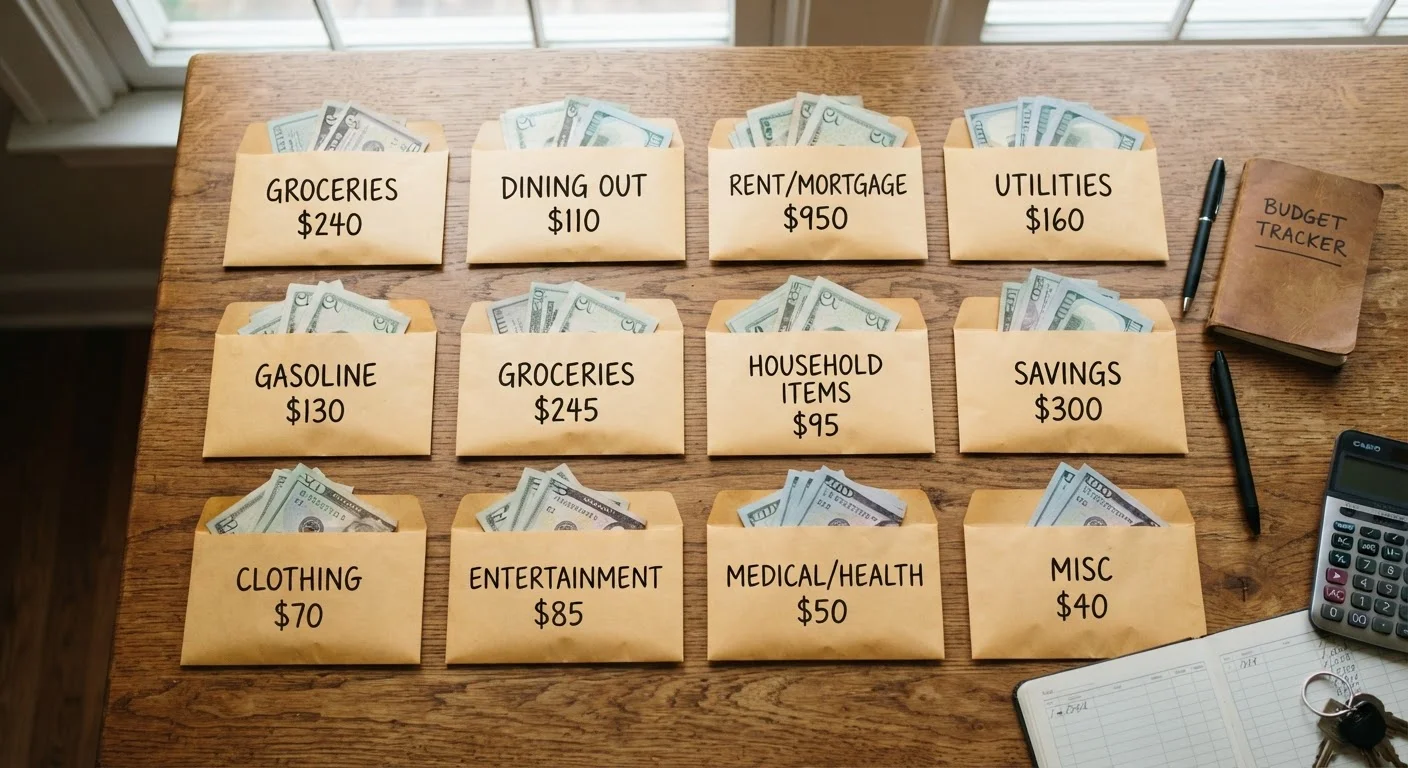
Envelope budgeting is a cash-based spending system in which you divide your monthly take-home pay into physical envelopes, each labeled for a specific category - groceries, dining out, gas, entertainment, and so on. Once an envelope is empty, spending in that category stops until the next month begins.
The concept has been around for decades and is grounded in a simple behavioral truth: spending physical cash feels more tangible than swiping a card. When you can see and feel your money leaving, you tend to think more carefully before spending it. If you want a refresher on foundational budgeting terminology before diving deeper, the personal finance glossary covers key terms like discretionary spending and cash flow in plain language.
The Advantages of Envelope Budgeting
Envelope budgeting has endured because it addresses one of the most common reasons people overspend: a lack of immediate feedback. Here is why it works well for many people.
Creates hard spending limits that are impossible to ignore
When an envelope is empty, spending stops - there is no abstract account balance to rationalize away. This hard boundary is one of the most effective ways to prevent overspending in categories like dining or entertainment.
Makes overspending immediately visible
Unlike checking a bank app days later, running low on cash in an envelope signals in real time that a category is nearly exhausted. This instant feedback helps adjust behavior before a problem grows.
No budgeting app or software required
The system needs only envelopes, cash, and a plan - making it accessible to anyone regardless of tech comfort level. This simplicity also removes the friction that causes many people to abandon more complex tools.
Reduces impulse purchases and emotional spending
Research in consumer behavior consistently finds that people spend less when paying with cash compared to cards. The physical act of handing over bills introduces a natural pause that digital payments skip entirely.
Builds awareness of spending patterns over time
Regularly handling your money category by category tends to reveal where your money actually goes versus where you thought it went - a valuable insight for improving future budgets.
For those building a budget from scratch, pairing this method with a structured monthly plan can help. See monthly budgeting from the ground up for a step-by-step foundation.
The Disadvantages of Envelope Budgeting
No budgeting system is without trade-offs, and envelope budgeting has some notable limitations that are worth weighing honestly.
Incompatible with digital and automatic payments
Most Americans pay utilities, rent, subscriptions, and loan bills electronically or via autopay. These transactions cannot flow through physical envelopes, forcing a split system that adds complexity.
Carrying significant cash creates security risks
Lost or stolen cash is generally not recoverable the way a fraudulent card charge might be. For people who commute or travel frequently, this is a meaningful practical concern.
Rigid category limits can feel punishing mid-month
Life is unpredictable. An unexpected car repair or higher-than-usual grocery bill can drain an envelope early and leave little room to adapt without raiding another category.
Time-consuming to set up and maintain
Withdrawing cash, sorting it into envelopes, and tracking what is left takes more hands-on effort than reviewing a digital budget summary. For busy households, this upkeep can become a barrier.
Misses out on card rewards and purchase protections
Paying with cash means forgoing cashback, travel points, and consumer protections that credit cards offer - a real trade-off for people who pay their balances in full each month.
~100%
Overspending visibility when envelope is empty
The binary nature of an empty envelope provides immediate, unambiguous feedback - a feature that bank apps and credit card statements often obscure with delayed or aggregated data.
12-18%
Estimated spending reduction when using cash vs. cards
Multiple consumer behavior studies have found that people tend to spend meaningfully less when transacting in cash, though exact figures vary by study design and spending category.
If you are comparing methods before committing, zero-based vs. percentage-based budgeting offers a useful side-by-side look at two popular alternatives.
Adapting the Envelope Method for Modern Life
The core logic of envelope budgeting - pre-assigning money to categories before you spend it - does not require physical cash to be effective. Several budgeting apps replicate the system digitally, letting you set category limits and track spending without handling bills and coins.
Digital Envelope Tools Are a Legitimate Option
Apps that mirror the envelope method allow you to assign portions of your income to virtual categories and track spending against those limits in real time. They preserve the core discipline of the system - pre-allocating money before spending it - without the need for physical cash. This makes the method more practical for people whose spending is largely card- or app-based. The digital envelope guide walks through how these tools work in practice.
Whether you prefer paper envelopes or a digital equivalent, the underlying discipline is the same: decide in advance where your money goes rather than figuring it out after the fact. This approach contrasts with percentage-based frameworks like the 50/30/20 rule, which offers broader spending buckets but less granular control. For a full guide on digital adaptations, see the envelope method in a digital age.
This article is for general informational purposes only and does not constitute personalized financial advice. Consult a qualified financial professional for guidance specific to your situation.