

Key Takeaways
Start With Research That Actually Narrows Things Down
Good trip planning begins not with booking a flight but with honest research. Before committing to any destination, gather information on three fronts: what the place actually offers, when the best time to visit is, and what kind of traveler experience it delivers.
Start with official tourism board websites and government travel advisories - these give factual baseline information on entry rules, local conditions, and seasonal patterns. From there, traveler forums and destination-specific guides help you understand ground-level logistics: transport options, neighborhoods, and realistic daily costs.
If you're exploring multiple destinations before settling on one, browse destination guides organized by region to compare what each place offers in terms of climate, culture, and accessibility.
Build your research shortlist by identifying what you want to do, not just where you want to go - then work backward to find destinations that match those activities and your available time.
Travelers who start with activity priorities rather than destination names report fewer mismatched expectations and make faster booking decisions.
When comparing lodging, check the walk-score or transit access around each property before booking - a room that costs 20% more in a central neighborhood often saves that difference in daily transport costs.
Location relative to your planned activities is often the highest-leverage variable in daily travel cost and convenience.
For first-time trip planners, a first-timer's roadmap walks through this early research stage in detail, including how to match a destination to your travel style and available time.
Building a Realistic Budget Before You Book Anything
A budget isn't a ceiling - it's a planning tool. Establishing rough cost ranges before booking means you can make informed tradeoffs rather than react to sticker shock after committing.
Key cost categories to estimate: round-trip transportation, nightly lodging multiplied by nights, daily food and drink, local transportation, activities and entrance fees, travel insurance, and a contingency buffer of roughly 10-15%. Use recent traveler reports and destination cost-of-living data to build realistic per-day estimates.
10-15%
Recommended contingency buffer in any travel budget
Travel planners and financial advisors broadly recommend adding a buffer of this size to account for unexpected costs such as medical needs, delays, or price increases.
72 hrs
Minimum lead time to recheck entry requirements
Entry rules, health declarations, and visa-on-arrival conditions can change; rechecking within 72 hours of departure is a widely recommended practice among experienced travelers.
For travelers working with tighter budgets, the pre-trip planning checklist for budget travelers outlines how to set spending limits across each category before departure. For a deeper look at managing money throughout an entire journey, budget travel from start to finish covers every stage from planning through coming home.
Booking Flights, Lodging, and Ground Transportation
Booking works best when treated as a sequence rather than a series of disconnected decisions. Start with the element that has the least flexibility - usually flights for international travel - and build outward from there.
When evaluating flight options, compare total journey time, not just price. A longer layover or redeye might save money but cost you a full day of energy at the destination. For lodging, cross-reference location against your planned activities: centrally located accommodation often offsets the need for expensive daily transport.
Book Ground Transport Before You Arrive
Research your airport-to-accommodation transfer options at the same time you book lodging, not after you land. Many cities offer cost-effective public transit routes from major airports that are significantly less expensive than taxis or rideshares. Knowing your route in advance reduces stress and decision fatigue on arrival day.
Ground transportation deserves attention before you land, not after. Research airport transfer options (public transit, shuttles, taxis) and decide in advance how you'll move around during the trip. Many destinations have transit passes or ride-share apps that are more economical than hailing individual rides.
Travelers weighing whether to self-plan or use a package deal can find a balanced breakdown in the case for and against all-inclusive vacation planning.
Documents, Entry Requirements, and Safety Prep
This section covers the parts of planning that carry the most consequence if overlooked. Entry requirements - visas, passport validity windows, proof of onward travel - vary by destination and nationality. Always verify directly with the destination country's official embassy or consulate website and the U.S. Department of State travel portal before finalizing bookings.
Verify Entry Requirements Directly With Official Sources
Visa rules, passport validity requirements, and health documentation requirements are set by individual countries and change independently of when you made your booking. Third-party travel sites may carry outdated information. Always confirm requirements through the destination country's official embassy or consulate website and the U.S. Department of State travel advisories site before departing.
Health-related entry requirements, such as vaccination records or health declarations, should also be confirmed through official sources, as these can change with little advance notice. Check requirements again in the weeks before departure, not just at initial booking.
Travel insurance is a separate but critical consideration. Policies vary widely in what they cover - medical evacuation, trip cancellation, lost baggage - so read actual policy terms before purchasing. This is general guidance; consult a licensed insurance professional if you need advice tailored to your specific situation.
For a broader view of how documentation and logistics fit into the overall planning framework, the anatomy of a well-planned trip explains each planning phase and why it matters.
Packing Smart: What to Bring and What to Leave
Overpacking is one of the most common and avoidable travel mistakes. A practical approach: build your list around activities and weather, not anxiety. Identify the three or four activities you'll actually do - city walking, hiking, beach time, a nice dinner - and pack specifically for those.
Layering is more versatile than packing for every temperature scenario separately. A lightweight base layer, a mid-layer, and a wind- or waterproof shell handle most conditions with far less bulk than multiple specialized outfits.
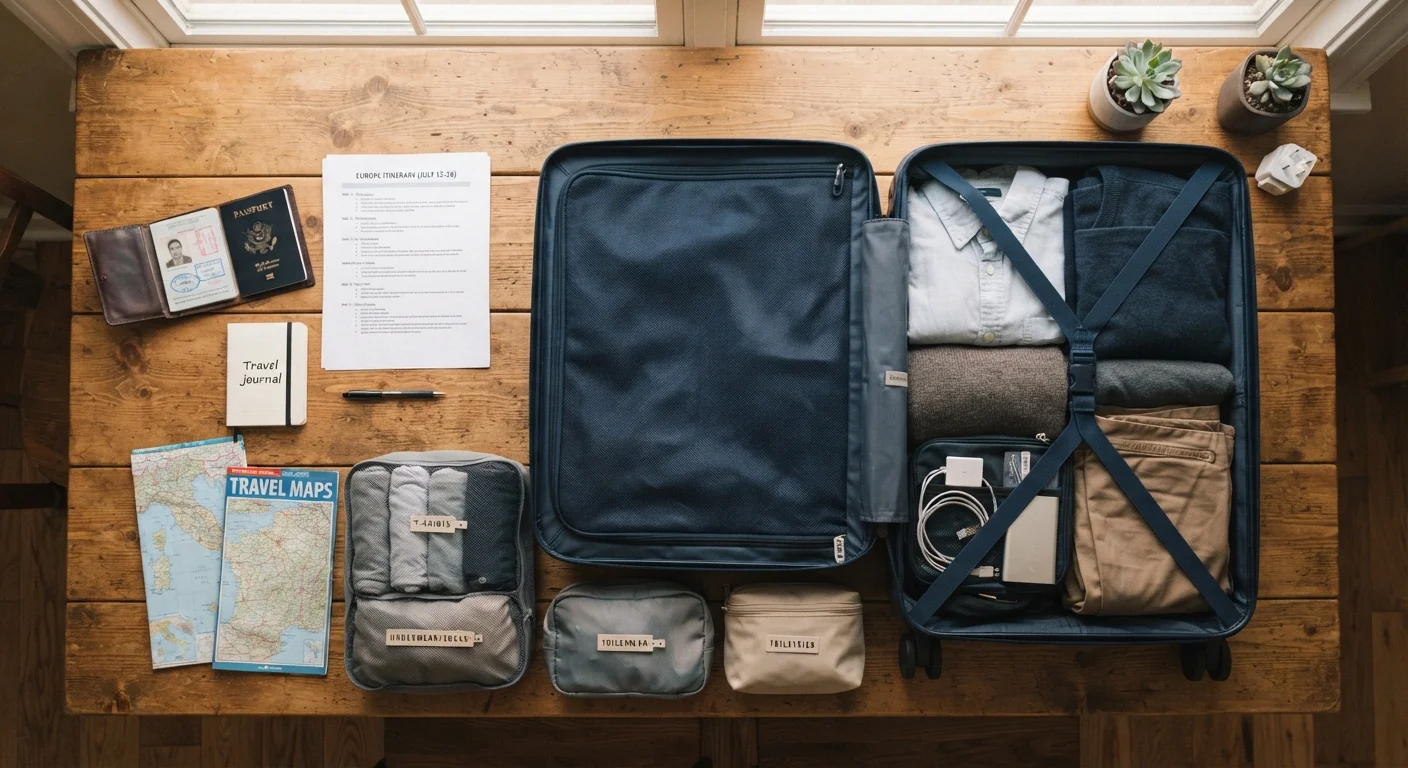
Packing cubes help maintain organization through multiple moves. Grouping items by category - clothing, tech, toiletries, documents - makes airport security and unpacking faster. Keep all travel documents, medication, and valuables in your carry-on regardless of checked baggage status.
Carry-On Rules Vary by Airline and Route
Carry-on size and weight allowances differ between airlines and can even vary on the same itinerary if multiple carriers are involved. Always verify the specific allowances for each flight segment in your booking before packing. International budget carriers in particular tend to have stricter and more variable policies than major U.S. carriers.
Arriving Ready: Your First 24 Hours at the Destination
The first 24 hours set the tone for the rest of the trip. Arriving with a loose but practical first-day plan prevents the disorientation that often leads to poor decisions - overpriced airport meals, unnecessary taxis, missed rest.
Before departure, confirm your accommodation check-in process (especially for late arrivals), identify a nearby option for a simple first meal, and note the local emergency number and nearest medical facility. These take five minutes to look up and can matter enormously if something goes wrong.
Give yourself permission to move slowly on arrival day. Jet lag, unfamiliar surroundings, and the mental load of navigating a new place are real. A short orientation walk, an early dinner, and a full night's sleep will leave you far more capable on day two than pushing through exhaustion to maximize the first evening.
Don't Sacrifice Sleep to Maximize Day One
Arriving exhausted and pushing through the first day without rest is a common traveler mistake that compounds across the whole trip. Fatigue increases the likelihood of poor decisions, minor accidents, and missed details. Treat adequate rest on arrival day as part of the plan, not an optional luxury.
For travelers using the travel on a budget hub as an ongoing reference, many of these arrival principles apply equally whether you're traveling on $80 a day or $300 - preparation doesn't require a large budget, just intentional planning.