

Key Takeaways
Alentejo Region
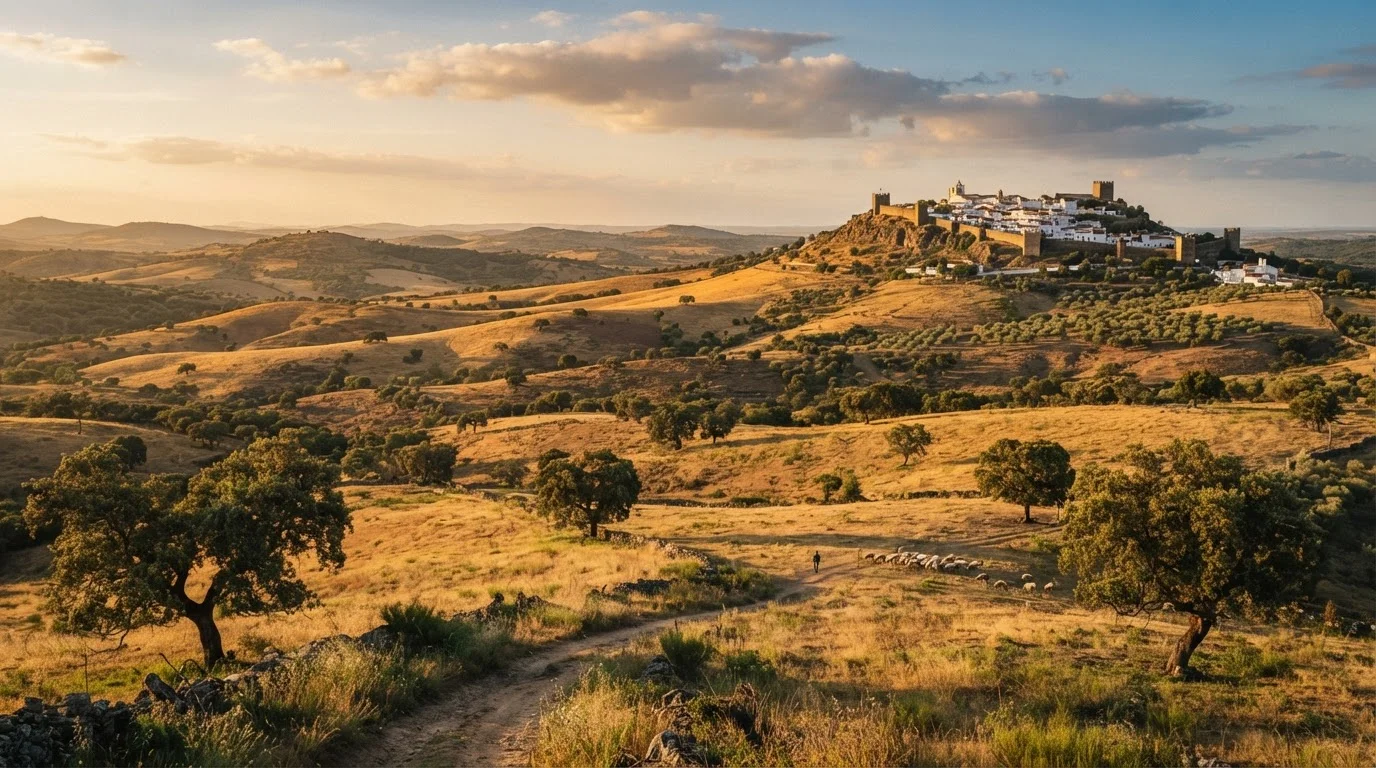
Alentejo is a large inland region of Portugal lying south and east of Lisbon, covering roughly one-third of the country's total land area. It's characterized by rolling plains, cork and olive groves, medieval walled towns, and some of Portugal's most respected wine production. The name roughly translates to "beyond the Tagus" - a nod to the river that forms its northern boundary.
Administratively, Alentejo is divided into Alto Alentejo and Baixo Alentejo (Upper and Lower), plus the sub-region of Alentejo Litoral along the Atlantic coast - each with distinct landscapes and appeal.
Why Travelers Are Skipping Lisbon's Surroundings for Alentejo
Lisbon earns every one of its visitors, but Portugal's capital and its coastal neighbors have grown crowded in ways that make genuine discovery harder. Alentejo offers something genuinely different: space, silence, and a pace of life that hasn't been packaged for tourism. Villages here still hold weekly markets. Winemakers still pour tastings at farmhouse tables. Roads through the cork forests can go quiet for miles.
The region attracts travelers who've done the Algarve beaches and want to understand a different Portugal - older, quieter, and tied more tightly to its agricultural roots. It also draws food and wine travelers who recognize that Alentejo produces some of the country's most interesting bottles and most honest cooking.
>50%
Share of world's cork supply from Portugal
Portugal is the world's largest cork producer; Alentejo accounts for a substantial portion of that national output.
~31,000 km²
Area of Alentejo region
Alentejo covers roughly a third of Portugal's mainland territory, making it the country's largest region by area.
250,000+
Population of entire region
With a relatively small population spread across a vast area, Alentejo is one of the least densely settled regions in the European Union.
The Landscape: Cork, Olive, and Open Sky
Alentejo's landscape is unlike anywhere else in Western Europe. The montado - a traditional land-management system mixing cork oak and holm oak forests with open grassland - dominates vast stretches of the interior. Portugal supplies more than half the world's commercial cork, and much of it comes from these slow-growing trees whose bark is harvested by hand every nine years without felling the tree.
Driving through these forests in spring, when wildflowers carpet the ground between the oaks, is one of the region's quieter pleasures. The southern plains flatten toward the Alqueva reservoir - Europe's largest artificial lake - where the dark-sky conditions are good enough that the area holds an international certification for stargazing.
Alqueva Dark Sky Reserve
The area around the Alqueva reservoir holds a Starlight Tourism Destination certification - a recognition tied to its exceptionally low light pollution. Several local operators offer guided stargazing sessions, particularly in the warmer months when skies are consistently clear. It's worth verifying current operators and availability through regional tourism resources before planning around this experience.
Medieval Towns Worth Your Time
Évora anchors most Alentejo itineraries for good reason. Its well-preserved Roman temple, 16th-century aqueduct, and the haunting Chapel of Bones (a small ossuary built by Franciscan monks) are all within walking distance of a compact historic center. UNESCO recognized the city's old town as a World Heritage Site in 1986.
Beyond Évora, the region rewards travelers willing to drive the back roads. Monsaraz sits on a hilltop above the Alqueva reservoir with stone-paved streets wide enough for one donkey cart - not much has changed in its proportions. Marvão, perched at nearly 900 meters near the Spanish border, has views that stretch across two countries. Estremoz is known for its marble - the town is built from it, quarried nearby - and for a Saturday market that fills its central praça with local produce, pottery, and hand-embroidered linens.
Alentejo Wine: What to Know Before You Go
The same heat that makes summer uncomfortable also ripens grapes with exceptional concentration. Alentejo wines, particularly the reds made from indigenous varieties like Aragonez (the local name for Tempranillo), Trincadeira, and Alicante Bouschet, have earned a strong international following. The region's whites and rosés, made under demanding hot-climate conditions, have also improved markedly.
Many quinta estates (wine estates) welcome visitors for tastings and cellar tours, though it's worth contacting them in advance rather than arriving unannounced. The town of Reguengos de Monsaraz and the area around Évora form the heart of the wine country most accessible to visitors. Drinking local here doesn't require any effort - nearly every village restaurant pours regional wine as a matter of course.
Book Quinta Visits in Advance
Many Alentejo wine estates welcome visitors, but they operate on smaller scales than organized wine tourism regions. Contacting a quinta directly - by email or phone - a few days before you arrive is the norm and usually appreciated. Showing up without notice can mean a closed gate, especially during harvest periods when staff are occupied in the vineyard.
Practical Considerations Before You Go
Alentejo is not a region that rewards rushing. Two to three nights is a reasonable minimum; a week lets you genuinely settle in. Accommodation ranges from simple guesthouses in village centers to herdades - traditional agricultural estates converted into rural hotels - where the grounds, the quiet, and the farm-to-table meals are as much the point as any particular sight.
Pack accordingly for the season. Summer heat is not a minor inconvenience; it's a significant planning factor. Many visitors find that scheduling outdoor activities in the early morning and returning to a shaded lunch and a rest makes hot-weather travel manageable. Autumn, when the light turns golden and the grape and olive harvests are underway, is particularly atmospheric. Always verify current entry requirements, road conditions, and local opening hours through official Portuguese tourism sources before travel, as these can change.
This article provides general travel information about the Alentejo region. Conditions, prices, and accessibility can change; verify details with official sources and service providers before making travel plans.