

| Navigation convention | Riverside / Lakeside (not North / South) |
| Oldest neighborhood | French Quarter (Vieux Carré), founded 1718 |
| Primary visitor corridor | French Quarter → Marigny → Bywater (walkable chain) |
| Streetcar lines serving tourists | St. Charles, Canal Street, Rampart/St. Claude (RTA New Orleans) |
| Best area for live local music | Frenchmen Street, Faubourg Marigny |
| Cultural heritage district | Tremé - one of the oldest Black neighborhoods in the U.S. |
How New Orleans Neighborhoods Work
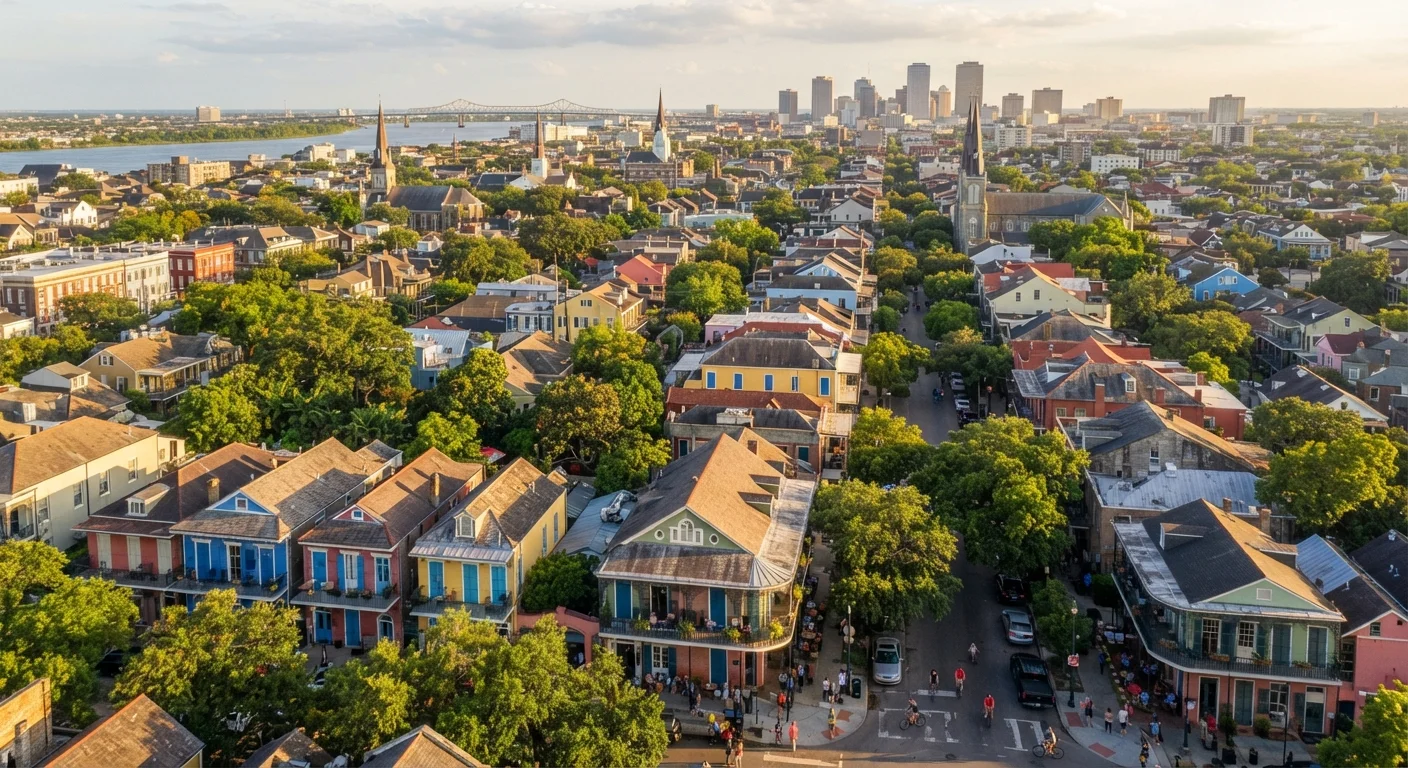
New Orleans is not a city you can absorb from a single vantage point. Its neighborhoods developed under French, Spanish, Creole, and American influences over three centuries, and that layered history gives each district a noticeably different feel - in architecture, food, music, and the pace of street life. Knowing the basics before you arrive helps you choose where to stay, where to eat, and where to spend your time based on what actually matters to you.
Geographically, the city bends along a crescent of the Mississippi River - which is why locals use "riverside" and "lakeside" rather than north and south for directions. Most visitor-facing neighborhoods cluster along the river's inner crescent, but several residential areas worth exploring sit further inland toward Lake Pontchartrain.
| Navigation convention | Riverside / Lakeside (not North / South) |
| Oldest neighborhood | French Quarter (Vieux Carré), founded 1718 |
| Primary visitor corridor | French Quarter → Marigny → Bywater (walkable chain) |
| Streetcar lines serving tourists | St. Charles, Canal Street, Rampart/St. Claude (RTA New Orleans) |
| Best area for live local music | Frenchmen Street, Faubourg Marigny |
| Cultural heritage district | Tremé - one of the oldest Black neighborhoods in the U.S. |
The neighborhoods below are grouped loosely by location and character. Use this as a lookup guide, not a ranked list - every district has trade-offs.
The Core Districts Every Traveler Encounters
French Quarter (Vieux Carré): The oldest urban neighborhood in the country and the most photographed. Its signature cast-iron balconies, courtyard architecture, and dense mix of bars, restaurants, and shops make it immediately recognizable. It's heavily tourist-oriented along Bourbon Street, but quieter streets like Chartres and Esplanade Avenue reveal a more residential, lived-in character. Noise and crowds are real; so is the historic appeal.
Marigny (Faubourg Marigny): Directly downriver from the French Quarter, the Marigny is where the local music scene breathes more freely. Frenchmen Street hosts live jazz and blues venues that draw neighborhood regulars alongside visitors. The housing stock leans toward colorful Creole cottages. It's walkable from the Quarter but noticeably calmer.
Bywater: Continuing downriver from the Marigny, Bywater has evolved into a hub for artists, independent restaurants, and renovated shotgun houses painted in bold colors. It's less polished than the Quarter, which is precisely the draw for travelers seeking a neighborhood that feels genuinely lived-in. The riverfront linear park known as the Crescent Park runs along its edge.
Shotgun house
A long, narrow single-story home where rooms are arranged in a straight line from front to back with no hallway. The style is common throughout New Orleans and is associated with Creole vernacular architecture.
Faubourg
A French term meaning suburb or neighborhood, used in New Orleans to refer to the residential districts that developed just outside the original French Quarter. Examples include Faubourg Marigny and Faubourg Tremé.
Creole cottage
A traditional New Orleans house type characterized by four rooms arranged in a square, a pitched roof, and a location close to the street - distinct from both the plantation house and the American-style townhouse.
Neutral ground
Local term for the median strip dividing a boulevard or avenue. In New Orleans, these grassy strips often serve as gathering spaces and are central to parade routes during Mardi Gras.
Neighborhoods with Deep Cultural Roots
Tremé: Widely recognized as one of the oldest African American neighborhoods in the United States, Tremé sits just behind the French Quarter and carries an outsized cultural weight. It's the birthplace of much of what the world recognizes as New Orleans jazz. Congo Square, now within Louis Armstrong Park, was a gathering place for enslaved and free Black people who maintained African musical and cultural traditions. Visitors should approach Tremé with awareness - it is a living residential community, not a heritage theme park.
Central Business District (CBD) and Warehouse District: The CBD functions as the city's commercial core, with hotels, the Superdome, and convention facilities. The adjacent Warehouse District has converted many of its 19th-century industrial buildings into galleries, restaurants, and loft residences. The National WWII Museum anchors the area and draws visitors year-round.
Safety and Street Awareness Vary by Block
Like any major American city, New Orleans has neighborhoods where safety conditions vary significantly from one block to the next. Before exploring less-trafficked areas, check current travel advisories and ask locally for up-to-date guidance. Well-lit, busy streets and awareness of your surroundings go a long way. No neighborhood overview can substitute for on-the-ground judgment.
Garden District: Upriver from the CBD across St. Charles Avenue, the Garden District is defined by grand Greek Revival and Italianate mansions set behind wrought-iron fences and live oak canopies. The streetcar along St. Charles Avenue is a practical and scenic way to travel between here and the Quarter. Magazine Street bisects the area with a long corridor of boutiques and cafés.