

Key Takeaways
Our Verdict
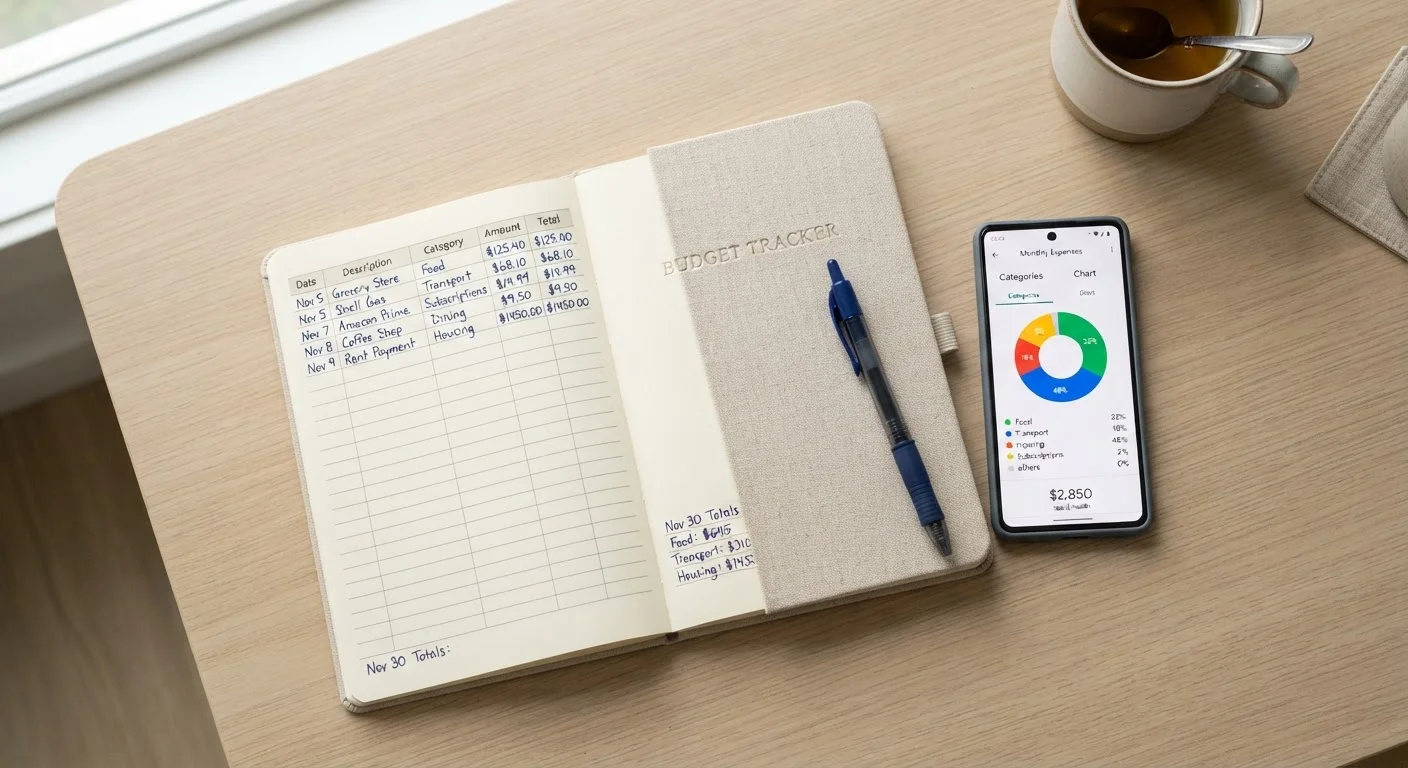
Both manual tracking and budgeting apps can be effective - the difference lies in how you spend and how you process information. Paper suits people who benefit from friction and deliberate reflection; apps suit those who want automation and real-time visibility. The right method is whichever one you'll actually use consistently.
| Best for | Recommended |
|---|---|
| Those who want to build deep, intentional awareness of spending habits | Manual (pen and paper) tracking |
| Those who make most purchases by card and prefer low-effort automation | Budgeting app |
| Cash-heavy spenders who can't rely on bank feeds for accuracy | Manual (pen and paper) tracking |
| People managing shared finances or multiple accounts simultaneously | Budgeting app |
Why Your Tracking Method Actually Matters
Budgeting advice often focuses on categories and percentages, but overlooks a more basic question: how will you actually record what you spend? The method shapes the habit. Choose one that clashes with how you naturally think or pay, and even a solid budget falls apart within weeks.
Before picking a system, it helps to do a quick review of recent spending. Our step-by-step spending audit walks you through the last 30 days so you can see your real patterns before building any structure around them.
With that foundation in mind, here's an honest look at what each approach delivers - and where each one tends to break down.
| Manual Tracking | Budgeting App | |
|---|---|---|
| Setup effort | Minimal - notebook and pen | Moderate - account linking required |
| Daily time commitment | 5-15 minutes of active logging | 1-5 minutes for review |
| Works for cash purchases | Yes, naturally | Only with manual entry |
| Spending awareness built | High - friction increases mindfulness | Moderate - automation reduces engagement |
| Risk of gaps or errors | Higher if days are skipped | Lower for card transactions |
| Privacy / data sharing | None - fully offline | Requires sharing bank credentials |
| Best for | Cash users, detail-oriented thinkers | Card users, busy schedules |
Tracking by Hand: The Case for Paper
Writing down every purchase creates a small but meaningful pause between spending and recording. That friction is actually the point. Research in behavioral economics suggests that manual recording increases awareness of spending in ways that automated tools don't always replicate - because you feel the act of logging a $6 coffee more acutely when you write it down.
Manual tracking works especially well for cash-heavy spenders. If you regularly pay with bills or use cash envelopes, no app will capture those transactions automatically - you have to enter them either way. A notebook removes the app entirely.
Keep It Simple to Start
If you're new to manual tracking, don't try to capture every sub-category on day one. Start with just five buckets: housing, food, transportation, personal, and everything else. Simplicity keeps you logging consistently, and consistency matters more than detail in the early weeks.
The real limitation is time and consistency. Skipping even two or three days creates gaps that distort your picture. You'll also spend time totaling columns that an app handles instantly.
Using a Budgeting App: The Case for Automation
Apps that link to your bank accounts and cards pull transaction data automatically, categorize purchases, and surface spending summaries without manual entry. For people who run most of their financial life through debit or credit cards, this eliminates significant friction and reduces the chance of missing a transaction.
Apps also make it easier to manage multiple accounts or shared finances in one place - a meaningful advantage for households tracking joint expenses. If you're working toward savings goals at the same time, pairing an app with automated savings transfers can create a nearly hands-off system for both spending visibility and saving progress.
Automation Without Attention Has Limits
An app that syncs your accounts only works if you actually review it. Studies on financial behavior suggest that passive data collection without regular check-ins rarely changes spending habits on its own. Schedule a weekly 10-minute review to stay engaged with what the app is showing you.
The limitation: automation can breed passivity. If you never log in, review the summaries, or act on what the data shows, the app becomes a financial diary nobody reads. Apps also require trusting third-party services with your banking credentials - a consideration worth weighing before linking accounts. For broader money tips that work alongside either method, see our everyday money tips hub.
How to Choose - and How to Make It Stick
Ask yourself two questions before deciding. First: do you pay mostly with cards, or do you frequently use cash? If cash is common, apps will always have blind spots. Second: do you tend to absorb information better by writing things out, or by seeing visual dashboards and charts?
If you're genuinely unsure, try manual tracking for two weeks, then switch to an app for two weeks. The method that produces fewer skipped days is the one more likely to work long-term.
Whichever approach you choose, the goal is the same: regular, honest visibility into where your money goes. That visibility - not the tool itself - is what makes budgeting work. For practical guidance on the saving and debt side of your finances, both methods give you the foundation you need to act.
This article is for general informational purposes only and does not constitute personalized financial advice. Consider consulting a qualified financial professional for guidance specific to your situation.